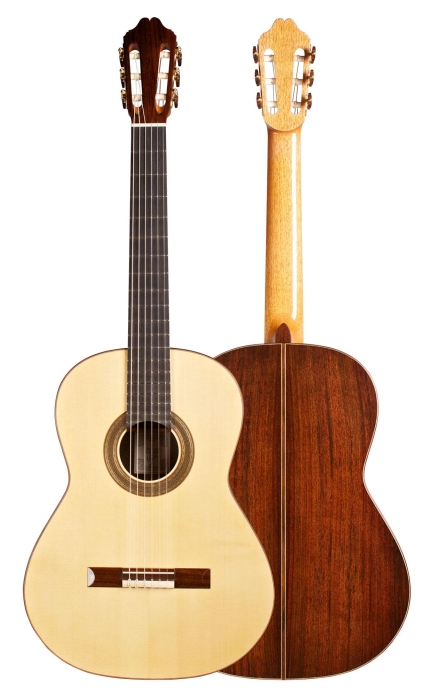
2024 Bertrand Ligier SP/AR
| Year | 2024 |
| Top | Spruce |
| Back & Sides | African Rosewood |
| Scale Length | 650 mm |
| Nut width | 52 mm |
| Finish | French Polish |
| Country | France |
| Luthier | Bertrand Ligier |
This guitar is no longer available in our inventory. If it interests you, click the ”notify me when available” button to be notified in the event that we re-acquire this guitar for re-sale.


"Can't Help Falling In Love" performed by Anastasia Malliaras & Taso Comanescu on a Bertrand Ligier

Chad Ibison performs his composition "Labyrinth" on a 2024 Bertrand Ligier classical guitar

Hugo Moltó performs "Prélude" by Hans Haug on a 2024 Bertrand Ligier classical guitar
Description
 This 2024 Bertrand Ligier is a classical guitar with a spruce top and African rosewood back and sides, built in the Languedoc region of southern France, with a Swiss spruce top aged 30 years and spruce-lined double sides.
Bertrand Ligier's 2024 Body Design
Like every guitar we receive from him, this one has his latest body design, built on many years of constant research. Always seeking to improve, Bertrand has again made slight modifications to give it more aesthetic balance - the proportions of the headstock and purflings have been adjusted accordingly as well. The tie block is inspired by Simplicio - a charming and subtle homage, done in his own way with the central part raised in relief like a carved jewel. New in many ways, yet still unmistakably French school - austere and complex, yet understated.
Six Full-Length Bars and Bouchet-Style Braces
Bertrand always seeks to increase the acoustic capabilities of his guitars while maintaining a beautiful quality of sound. In late 2019 he made the difficult technical decision to leave the French mounting technique for the Spanish method - changing several details of his building process, including making new moulds - to improve the relationship between the neck and body, particularly the soundboard. The result is a more balanced guitar, with strong and lyrical basses and an especially improved first string; the sound is as classy as ever, with perhaps a bit more old-world charm. The bracing has six full-length bars placed symmetrically, three on each side. Instead of a center brace there is a "half" bar from the bridge to the foot, plus two shorter braces fanning away from the soundhole to the bridge, and two Bouchet-style braces - under the front edge of the bridge and just behind it - giving the bridge a very flexible area to move in while staying structurally stable. The sides are doubled, as always with Bertrand - the inside layer is spruce, which Bertrand chose for its lightweight quality and because it was often used for back and sides during the Romantic period (for example in the instruments of René Lacote). A stiffer yet still lightweight body sends more of the vibration into the soundboard, improving projection in concert settings and giving deeper, sturdier basses and more rounded, focused trebles.
Craftsmanship and Sound
Beyond the sound, Ligier has become recognized for his remarkable woodworking skills - the detail in his inlay work rivals the most skilled woodworkers in the trade, and his perfectly executed rosettes are a hallmark of his work. This one has a new variation on the "bean" mosaic inspired by Daniel Friederich's famous rosette. His French polish has a mirror-like, perfectly even sheen over the entire instrument. Great style, delivered with virtuosity. The top is a beautiful Swiss spruce aged 30 years, with an exquisite set of colorful African rosewood for the back and sides, and the tuners are Alessi H1 with black horn buttons. Sound and looks are well matched - precise balance, supreme clarity between the voices, and a sophisticated tone with a very pronounced fundamental and highly controlled overtones. Incredibly satisfying on all counts, and a guitar we recommend to any player, from the advanced student to the accomplished professional.