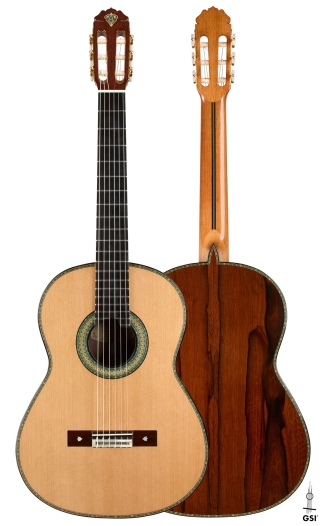
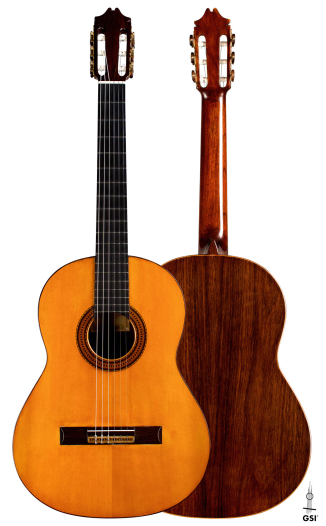
This 2026 Tobias Berg "Bouchet" is a classical guitar with a spruce top and Indian rosewood back and sides, built in Germany as his 154th instrument - the same number of guitars Robert Bouchet made in his lifetime.
Tobias Berg's 30th Anniversary and 50th Guitar for GSI
In 2025 Tobias Berg reached a major milestone in his career - his 30th anniversary as a guitar maker - which got him thinking about a new and creative project to mark the occasion. Several other fortunate coincidences were lining up at the same time, so it gradually became clear to him what he would do: build the next guitar for GSI (his 50th for us - wow!) and his 154th guitar to date. What's so special about the number 154? One of Tobias' great all-time heroes, Robert Bouchet, built only 154 guitars in his entire output. So Tobias decided that for his 154th guitar, he would honor Bouchet in a very personal way - and this is the guitar that was created as a result.
A Fusion of Berg and Bouchet
What Tobias has done here is absolutely extraordinary. This instrument is unlike anything we've ever seen before by any maker. It is a harmonious "fusion" of a Berg guitar blended seamlessly with a Bouchet. This is not a bench copy of a Bouchet, nor a "structural copy" ignoring the aesthetics of the original - this is something new. Look at the rosette: that is unmistakably a rosette Bouchet could have made, except that it has Berg's well-known mosaic in it! Same with the headstock - the angle, slots, multi-layered purfling and even the button shapes on the machines are Bouchet, but the carving and design are Berg. Same with the heel, plantilla, tie-block inlay and more.
Sound: Bouchet's Creamy Trebles, Berg's Warmth
Of course we are also enamored with the sound of this guitar. Like its appearance, we hear hints of Bouchet here and hints of Berg there - it fuses complementary qualities of both luthiers into a truly compelling sound, with the creamy, thick yet smooth trebles of Bouchet and the boxy (almost Friederich-like) warmth of a Berg. Much more could be said, but it's best to hear it from the luthier himself - his notes follow below. Overall a huge success and an inspired project: our congratulations to Tobias on achieving something very remarkable to commemorate 154 guitars built over 30 years, and the 50th guitar built for us!
In Tobias Berg's Words
"The process of building a Bouchet Homage guitar" by Tobias Berg
My 154th guitar was about to be born. Since Robert Bouchet built exactly that number during his lifetime, I thought it would be a proper way to celebrate one of my heroes and gain some new insights and joy while doing so.
It’s been very interesting to notice all the little details that are actually different from what I normally build. Bouchet was quite unique in the fact that he came up with his headstock design right from the start, basically from guitar No. 1. He also insisted on using a narrower drill (12–13 mm) for making the two windows for the strings (except for the flamenco guitars with pegs, obviously). On all the guitars I’ve seen from him, the strings touch the side of the headstock on their way to the tuner. For some reason, he decided not to purchase a larger diameter drill and kept doing it like this for 154 guitars. I find that fascinating, since he was obviously a very intelligent gentleman and had exchanges with other luthiers who all simply used a standard 16 mm drill.
I purchased a 14 mm drill to give the impression of a narrower window, but I’m still hoping that with a few turns of string on the tuner, it will pass without touching the wood. I decided to make my own headstock design (crown) since it’s not a 1:1 copy of a particular instrument. However, I’ve kept his design principle of using additional veneers underneath the face veneer of the headstock, something I normally don’t do.
The body shape I decided upon was copied from the Roy Courtnall plan, which is from a 1963 guitar, possibly No. 92, one of Julian Bream’s three Bouchet guitars. The measurements differ only a few millimeters from what I normally build; they are not outrageously different, but in the end, it is uniquely a Bouchet plan. I also adhered to his method of letting the sides in at 90° to the neck, a unique trait that gives the sides his signature "hump." Normally, sides meet the neck following the curve of the upper bout, and it’s never a perfect 90° cut. I attached the top using individual gluing blocks just like he did, and used his bracing pattern with the barre d´âme, inspired by his 1958 Ida Presti guitar. The back has two lines of pear wood veneer instead of maple, and the sides have only one line. This was something he established more or less from the beginning and also kept for the rest of his life.
The top has three decorative lines, but I decided to use blue colored veneer since that was the color my first guitarmaking teacher used in Sweden back in 1995. It’s a tip of the hat to him and a thanks for putting me on this path all those years ago. The soundhole is placed slightly higher toward the headstock so that the 19th fret is divided. This is something I never do otherwise. The rosette is my traditional "weave" pattern, again using pear wood, blue, and maple. The width and arrangement of the lines inside and outside of the mosaic are very Bouchet-inspired, resulting in a wider rosette than is normal for me. The bridge has the Bouchet dimensions and lacks the little lip behind the tie-block, another departure from my norm. The bone overlay is inlaid with the mosaic from the rosette, again a hint at the Master. Side height is within his ballpark. Measurements from nine of his instruments all vary by a few millimeters, which is normal for "hand-made" work versus a manufacturing plant where they churn out identical instruments thanks to CNC machinery. The back reinforcement is the typical wide piece of mahogany, and the shaping of the heel and foot has been an attempt at channeling his work rather than my own standard look. The back is attached to the sides with kerfed lining, again just like he used to do. The tuners are handmade by Alessi in Italy and custom ordered, his Bouchet model. However, the worm gear is mounted behind the pinion gear, unlike the old, cheap French tuners Bouchet customized himself. Finish is traditional French Polish.
It has been a fun and unusual journey trying to get inside somebody else’s mind during the building process. Why did he do it like this, or like that? I believe that he thoroughly loved building guitars, it was a calling, just like painting not a job! Simply put, he was a creative genius at his core. This is a special guitar to me and I have loved the process very much. Whenever it’s the time of year where I have a few days off, it’s inevitable that I start dreaming of what to build next. After being out of the shop for just two or three days, my mind gets going again. It’s something I can’t stop (and don’t want to stop) or control. It’s simply who I am - a guitar maker at heart.
– Tobias Berg, April 2026
Photos of this guitar taken shortly after completion