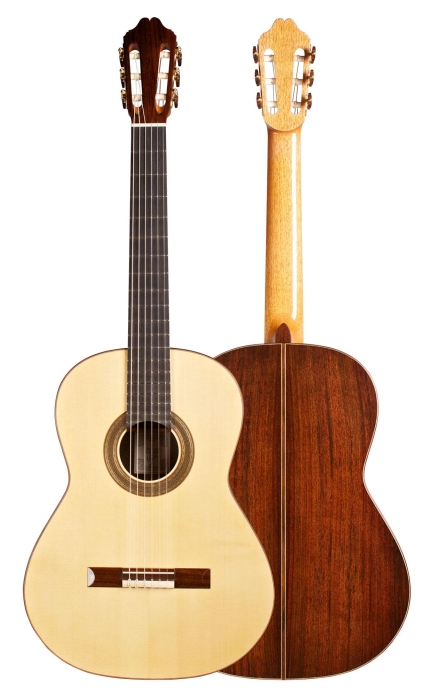
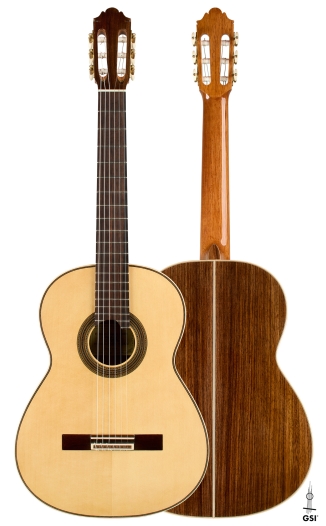
2021 Bertrand Ligier SP/AR
| Year | 2021 |
| Top | Spruce |
| Back & Sides | African Rosewood |
| Scale Length | 650 mm |
| Nut width | 52 mm |
| Finish | French Polish |
| Country | France |
| Luthier | Bertrand Ligier |
This guitar is no longer available in our inventory. If it interests you, click the ”notify me when available” button to be notified in the event that we re-acquire this guitar for re-sale.


Johann Sebastian Bach's "Violin Sonata BWV 1001: II. Fugue" by Max Müller on a 2021 Bertrand Ligier
Description
 This 2021 Bertrand Ligier is a classical guitar with a spruce top and African rosewood back and sides, built in the Languedoc region of southern France, among his first instruments built using the Spanish method.
Bertrand Ligier's 2021 Design
We're very pleased to be working with this fine maker, and this is an impressive concert-level guitar in every regard. Like every guitar we receive from him, this one has his latest body design, built on many years of constant research. Always seeking to improve, Bertrand has again made slight modifications to give it more aesthetic balance - the proportions of the headstock and purflings have been adjusted accordingly as well. The tie block design at the bridge is inspired by Simplicio - a very charming, yet subtle homage to one of his influences, but done in his own unique way with the central part in relief, almost like a carved jewel. Although "new" in many ways, this is still clearly in the style of the French school - austere and complex, yet understated.
From French Mounting to the Spanish Method
Bertrand's quest, soundwise, is to increase the acoustic capabilities of his instruments as much as possible while keeping a beautiful quality of sound. That is why, in late 2019, he moved from the French mounting technique to the Spanish method, to improve the relationship between the neck and body - and particularly the soundboard. It was a difficult technical decision, since it meant changing several details of his building process, new moulds included. His guitars since then are more balanced, with strong, lyrical basses and an especially improved first string - as classy as before, with perhaps a little more old-world charm. The bracing of the top has five full-length bars (and two shorter ones towards the center) with an asymmetrical bar under the rosette. As with his previous instruments, this one has double sides - the inner layer being of spruce, which Bertrand chose for its lightweight quality and because it was often used for back and sides during the Romantic period (for example in the instruments of René Lacote). This makes the body stiffer yet still lightweight, which in turn helps direct more vibration to the soundboard. This improves projection (particularly in concert settings) and the depth and sturdiness of the basses, as well as giving more rounded and focused trebles.
European Spruce and African Rosewood
Bertrand is known not only for his quality of sound but also for his remarkable woodworking. His inlay work shows an attention to detail that is second-to-none, and his intricate, perfectly executed rosettes have become a hallmark. The pore-filling and French polish have a mirror-like sheen that is perfectly consistent over the whole guitar - a maker with a great sense of style and real virtuosity in the delivery. Materials are also first-rate: a beautiful European spruce top and an exquisite set of African rosewood for the back and sides. Tuners are Alessi H1 with ebony buttons. Sound and looks are well matched - precise balance, supreme clarity between the voices, and a sophisticated tone with a very pronounced fundamental and highly controlled overtones. Incredibly satisfying on all counts, and a guitar we recommend to any player, from the advanced student to the accomplished professional.