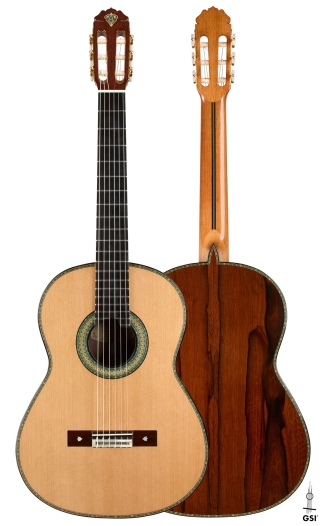
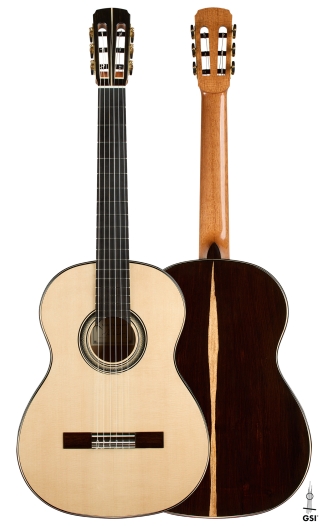
Hermann Hauser III (b. 1958) and his daughter Kathrin Hauser are the fourth and fifth generations of the Hauser family of guitar makers in Reisbach, Germany. Working in the same workshop as Hermann Hauser I and Hermann Hauser II, with many of the same tools and woods, they preserve the "teutonic" Hauser sound made famous by Andrés Segovia and Julian Bream.
At a Glance
- Hermann Hauser III born: 1958
- Workshop: Reisbach, Germany (the Hauser family workshop)
- Building since: 1974, alongside his father, Hermann Hauser II
- Kathrin Hauser: his daughter (b. 1982), the fifth generation; trainee from 2005, first guitar 2006 (presented in Tokyo), guitar-making exam 2007, orders under her own name since 2008
- Labels: "Hermann Hauser – Gitarren – Reisbach, früher München", dated "A.D." and numbered by hand – Hermann III from No. 86 (1983) to No. 764 (2016) at GSI; Kathrin signs and numbers her own
- Models: the "Segovia" (after the 1937 Hauser I), the "Llobet" and special editions
- Played by: Pepe Romero, Celedonio Romero and many concert artists
Hermann Hauser III: Fourth Generation in Reisbach
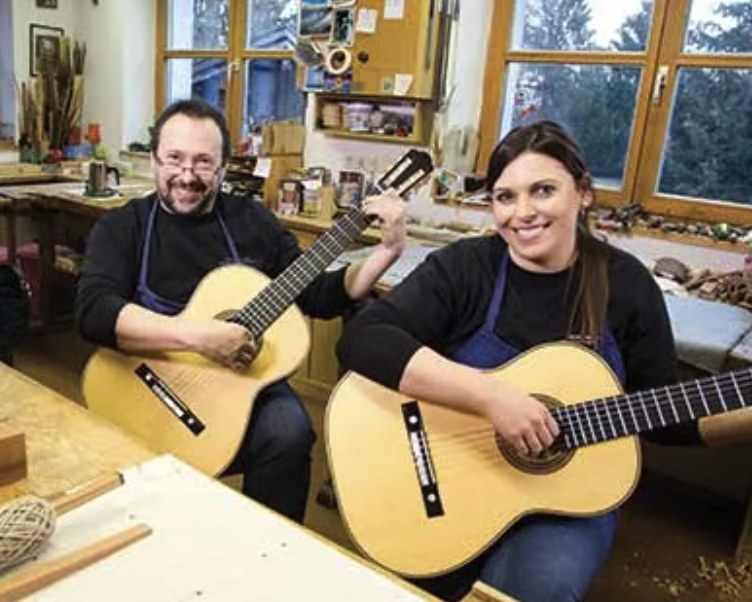
Since 1974, Hermann Hauser III has worked together with his father in the same workshop. His guitars were described as instruments with an indescribably beautiful sound by Andrés Segovia. Pepe Romero says his Hauser guitar is an instrument with the purest sound. Hermann Hauser III cultivates good relations with his guitarists and makes guitars fitting the needs of particular players, and he has received the highest awards from professional organizations and the international guitar community.
The "Teutonic" Hauser Sound
Hermann Hauser III has tirelessly built guitars that capture the sound and aesthetic of the "teutonic" style, as initially established by his grandfather, Hermann Hauser I, and transmitted through his father, Hermann Hauser II. Although it is one of the most iconic (and copied) styles since its inception, it should be no surprise that the style has been most faithfully preserved by Hermann III – indeed he works in the same workshop as his father and grandfather, uses many of the same tools, and even uses woods that were acquired by both his paternal predecessors. Features of the "teutonic" style are the extreme clarity and balance between voices, even sustain in all registers, and of course incomparable beauty of tone. The sound of this style of instrument has been most famously immortalized by Julian Bream in countless recordings, as well as by numerous other major players.
We believe Hermann Hauser III guitars to be more like a Hauser I than any other maker's in the world. We have compared these guitars in blind tests with Hauser I and Hauser II instruments and found them remarkably similar. Julian Bream once said these guitars have an "aristocratic" tone – we believe that is an apt description. One unique example in our Museum, made for Celedonio Romero, was built by Hermann III on a soundboard of his grandfather, dating from 1946.
Kathrin Hauser: The Fifth Generation
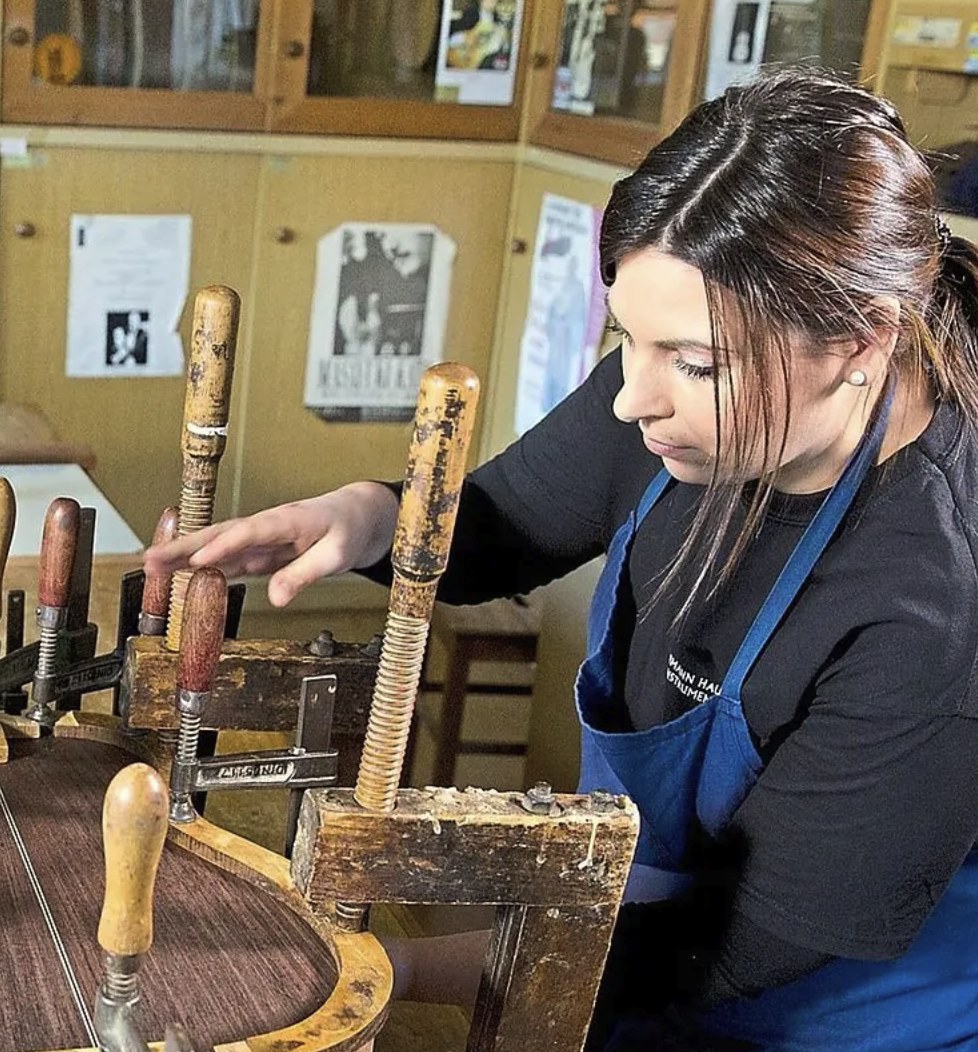
Kathrin Hauser is the fifth-generation builder of the Hauser workshop, following her great-grandfather Hermann Hauser I, her grandfather Hermann Hauser II and her father Hermann Hauser III. Born in 1982 – exactly 100 years after Hermann Hauser I – she studied business administration and worked in business, building guitars on weekends, before joining the workshop as her father's trainee in 2005. Her first guitar, built in 2006, was presented in Tokyo and featured by Japan's largest guitar magazine; she passed her guitar-making exam in 2007, and since 2008 musicians around the world have ordered her guitars – each one made to order, in the traditional Hauser methods and designs. The family's wood store, started by Hermann Hauser I, still holds woods over 100 years old (for every set taken, two are bought), and tools of Josef Hauser, Hermann I and Hermann II are still in use, among them a band saw from 1905. Kathrin and her father work side by side in the same Reisbach workshop as Hauser I and II, using many of the same tools and even woods acquired by their predecessors, and her guitars – like her 2013 "Segovia" model – have all the classic Hauser qualities: great balance, evenness of sustain and supreme clarity.
Her 2019 guitar has a redwood top that was joined, and its rosette inlaid, by Hermann Hauser II in 1973, when he built one instrument from the same wood. Hermann III has also built a guitar with this wood, so as far as we know there are only three such instruments – one from each of the last three generations of the Hauser workshop.
Hauser in Orfeo Magazine
 Orfeo Magazine No. 4: Hauser III, Blöchinger and Ober
The French classical guitar magazine's feature on Hermann Hauser III, Edmund Blöchinger and Fritz Ober.
Books on the Hauser Family
Orfeo Magazine No. 4 (above) is part of the Orfeo 1-5 collection, and our 1988 Hauser III No. 207, from the Russell Cleveland collection, is shown on pages 80–81 of The Classical Guitar – A Complete History:


Hermann Hauser III on Video
Hermann Hauser III and Kathrin Hauser Guitars at GSI
Many Hermann Hauser III guitars – and the first guitars of Kathrin Hauser – have passed through our doors over the years. You'll find guitars currently in stock by clicking the "Guitars In Stock" button in the header of this page as well as earlier examples in our Museum by clicking the "Guitars In Museum" button.
Frequently Asked Questions
Who is Hermann Hauser III?
A German classical guitar maker, born in 1958, the grandson of Hermann Hauser I; he has worked in the family workshop in Reisbach since 1974.
Who is Kathrin Hauser?
Hermann Hauser III's daughter and the fifth generation of the Hauser family of guitar makers, working with her father in Reisbach.
When was Kathrin Hauser born?
In 1982 – exactly 100 years after her great-grandfather Hermann Hauser I. She began as her father's trainee in 2005, built her first guitar in 2006, passed her guitar-making exam in 2007, and has built guitars under her own name since 2008.
How close is a Hauser III to a Hauser I?
Very close – in our blind tests with Hauser I and Hauser II guitars we found them remarkably similar: clear, balanced, with even sustain in all registers.