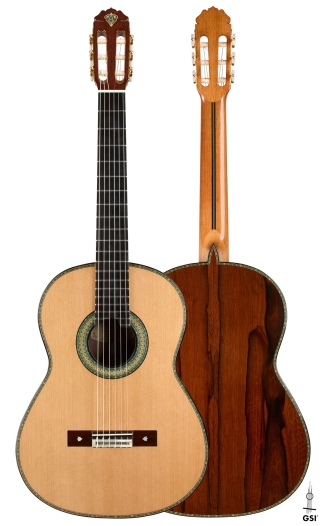
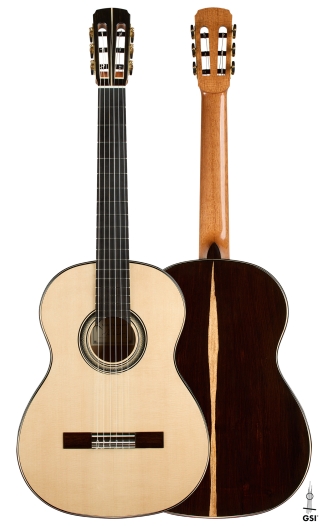
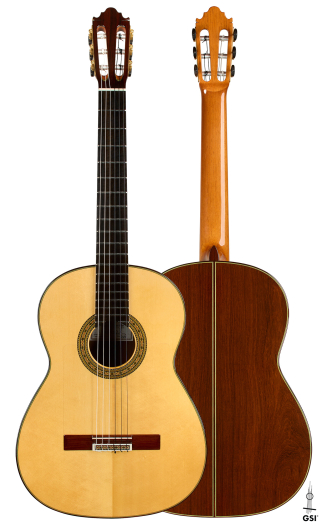
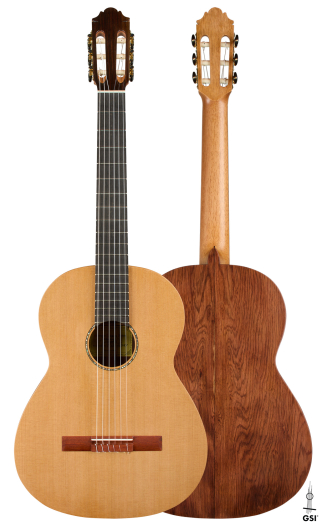
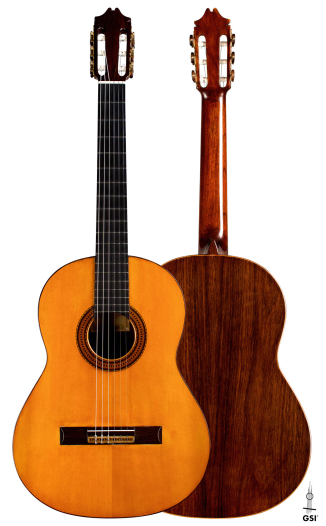
1946/1990 Hermann Hauser I/III No. 259 SP/CSAR (ex Celedonio Romero)
| Year | 1946/1990 |
| Top | Spruce |
| Back & Sides | CSA Rosewood |
| Scale Length | 650 mm |
| Nut width | 52 mm |
| Finish | French Polish |
| Country | Germany |
| Luthier | Hermann Hauser III & Kathrin Hauser |
This guitar is no longer available in our inventory. If it interests you, click the ”notify me when available” button to be notified in the event that we re-acquire this guitar for re-sale.


Bach 'Violin Sonata No. 1 - Adagio (BWV 1001)' played by Yuri Nugmanov

Hermann Hauser III - Classical Guitar at Guitar Salon International
Background
Hermann Hauser III: Fourth Generation of the Hauser Dynasty
Hermann Hauser III (b. 1958) – grandson of Hermann Hauser I and son of Hermann Hauser II – has worked in the Hauser family workshop in Reisbach, Bavaria, since 1974: first alongside his father, and today with his daughter Kathrin, the fifth generation. He works in the same workshop as his father and grandfather, uses many of the same tools, and even uses woods that were acquired by both his paternal predecessors. The family's wood store, started by Hermann Hauser I, still holds woods more than 100 years old – and for every set taken out, two are bought to replenish it – while tools of Josef Hauser, Hermann I and Hermann II are still in daily use, among them a band saw from 1905. His label still reads "Hermann Hauser – Gitarren – Reisbach, früher München" (formerly Munich), with the year after "A.D.", the number and his signature. He attaches it at the start of a build, so there is often a year or more between the date on the label and the guitar's completion.
His guitars were described by Andrés Segovia as instruments with an indescribably beautiful sound, and Pepe Romero says his Hauser is an instrument with the purest sound. Hermann III cultivates good relations with his guitarists, makes guitars fitting the needs of particular players, and has received the highest awards from professional organizations and the international guitar community.
The "Teutonic" Hauser Sound
Hermann Hauser III has tirelessly built guitars that capture the sound and aesthetic of the "teutonic" style, as initially established by his grandfather and transmitted through his father. Its features are the extreme clarity and balance between voices, even sustain in all registers, and of course incomparable beauty of tone – a sound most famously immortalized by Julian Bream in countless recordings, who once said these guitars have an "aristocratic" tone. We believe Hermann Hauser III guitars to be more like a Hauser I than any other maker's in the world: in blind tests with Hauser I and Hauser II instruments we found them remarkably similar.
His standard model is the "Segovia", essentially the same design as Segovia's 1937 Hauser I; he also builds the "Llobet" (after the 1859 Torres of Miguel Llobet, as did his father and grandfather), a "Bream" model and special editions after early Hauser I designs.
Books on the Hauser Family
Orfeo Magazine No. 4 is devoted to the Hauser dynasty, with a feature on Hermann Hauser III, Edmund Blöchinger and Fritz Ober – read the issue online or find it in the Orfeo 1-5 collection: