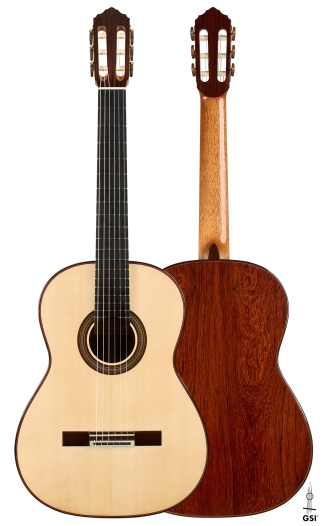
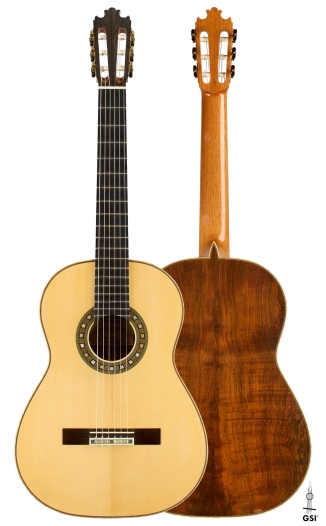
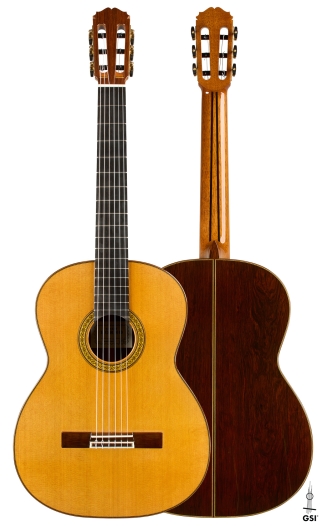
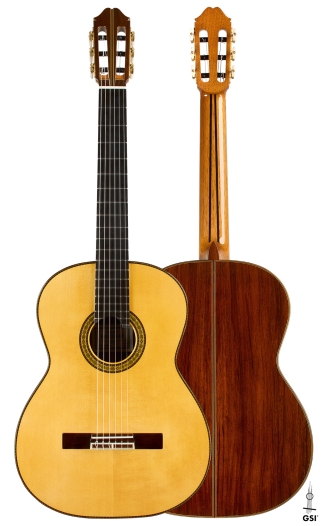
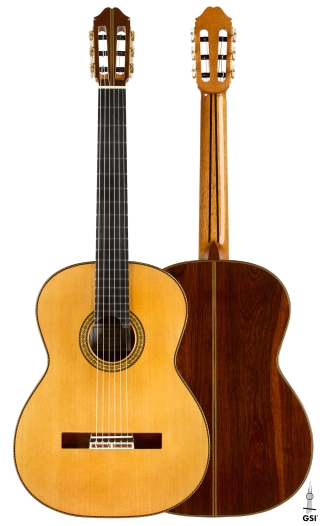
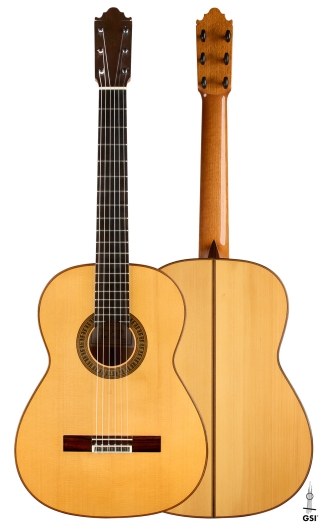
Miguel Rodríguez is the name of one of the most celebrated workshops in the history of the Spanish guitar: a family of four classical and flamenco guitar makers, spanning three generations, who worked in Córdoba, Spain, until 1998, and whose guitars have been played by all members of the Romero family.
At a Glance
- Workshop: Córdoba, Andalucía, Spain – San Fernando 70, then Calle Alfaros 15 from 1939 until it closed in 1998
- The makers: Miguel Beneyto Rodríguez (1888–1975), his twin sons Rafael Rodríguez Serrano (1921–1965) and Miguel Rodríguez Serrano (1921–1998), and Miguel Jr.’s son José Rodríguez Álamo (1949–1996)
- Guitars: classical and flamenco
- Best-known models: the “Churchdoor” and the decorated “Centenario”
- Who built it: shown by the position of the oval stamp on the label
- Roots: the tradition of Antonio de Torres
- Famous players: the Romero family, for over six decades
Guitar Makers of Córdoba
This famous family of guitar makers was based in the city of Córdoba, which is nestled deep in Andalucía – the region of southern Spain that gave birth to the modern Spanish guitar in the person of Antonio de Torres (1817–1892), who had been active in neighboring Seville and Almería. The slimmer and sleeker style of the Rodríguez guitar is regarded by many to be an enlarged and “modernized” traditional guitar with its roots stretching back to Torres, with little modification to any of the critical design elements of bracing, proportions and dimensions. Yet these guitars have a unique majesty of their own, with great subtlety of contour and texture to the tone, and their own distinct evolutionary history.
Four Makers, Three Generations
Throughout the 20th century, the Rodríguez family produced some of the most compelling instruments in Spain, if not the world over. When speaking of “Miguel Rodríguez”, one is actually referring to four makers – Miguel Beneyto Rodríguez (1888–1975, also known as “Miguel Sr.”), his twin sons, Rafael Rodríguez Serrano (1921–1965) and Miguel Rodríguez Serrano (1921–1998, also known as “Miguel Jr.”), followed by Miguel Jr.’s son, José Rodríguez Álamo (1949–1996, also known as “Pepe”).
The Evolution of the Miguel Rodríguez Guitar
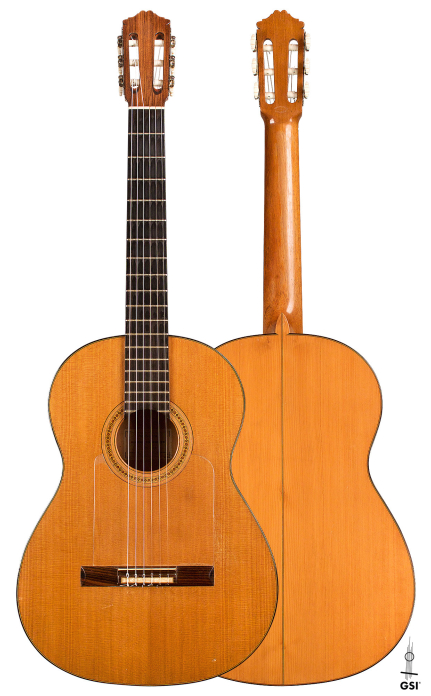
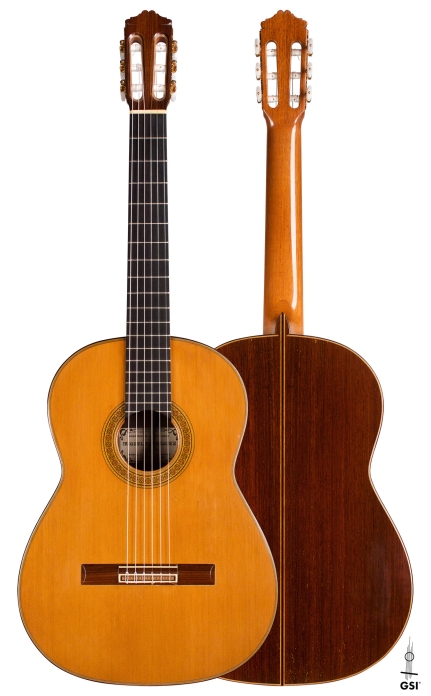
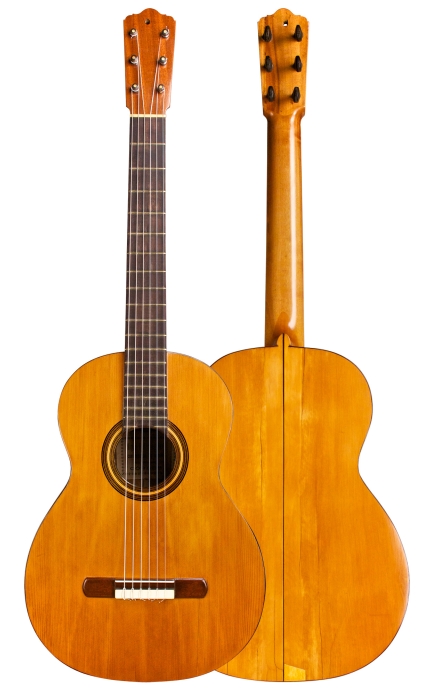
The early period was dominated by Miguel Sr., whose instruments were lightly built and small-to-medium-bodied, with a very expressive, lyrical and singing quality to the sound. They also had overwhelming resonance and projection, which made them perfect instruments for playing without amplification with orchestras or in large halls. As Miguel Jr. and Rafael rose to prominence in the 1950s and 1960s, the guitars evolved into a more consistent, streamlined style with increased body proportions, still quite lightweight, with a 7-fan build.
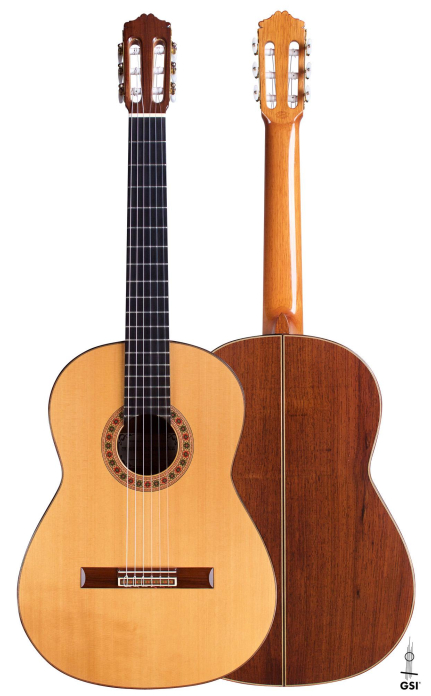
The later (1970s–1998) period of Miguel Jr. and his son Pepe is perhaps the best-known phase, where the instruments tend to have longer scales, deeper boxes, a more lightweight bracing system of 5 fans, and are more commonly found with cedar tops. This is the “Churchdoor” as well as the decorated “Centenario” period – the Centenario guitars, created to celebrate the 100th anniversary of Miguel Sr.’s birth (1888–1988) and built until the end, feature not only the finest of materials but additional inlay in the rosette and purfling. Despite the larger build at this time, the instruments are known in particular for maintaining a very lightweight build and yielding a fast, flamenco-like response with a warm, romantic and soulful Spanish character.
Reading a Rodríguez Label
The earliest labels give the family’s first address, San Fernando 70 – in the 1920s “Miguel Rodríguez, Constructor de toda clase de instrumentos de cuerda”. In 1939 the workshop moved to Calle Alfaros 15, and every label from then on carries that address: blue patterned and script labels in the 1950s, an ornate grey label around 1958–59, the red and blue “Constructor Miguel Rodríguez, Año 1.9.., Alfaros, 15, Córdoba” from the 1960s to about 1980, and an art-nouveau “Constructor de Guitarras” label from the early 1980s.
Because all four makers used the same printed label, the family showed who built each guitar with the position of a small, peanut-shaped “M. Rodríguez · Córdoba” stamp in purple ink – often half on the label and half on the wood, and sometimes faded: no stamp – Miguel Sr.; upper right corner – Rafael; lower right corner – Miguel Jr.; midway down the right edge – Pepe. From the mid-1970s the labels were also signed “Miguel Rodríguez”. Centenario labels are marked “Centenario”, from 1992 “Centenario 1888–1988”, and a few carry a dedication, such as “Construida para Angel Romero”.
The Last Rodríguez Guitars
José “Pepe” Rodríguez built one of his final instruments for Angel Romero, who named it “La Califa” and used it on his recording Rodrigo – Works for Solo Guitar. In 1996 Pepe Rodríguez started a last batch of three guitars, but he fell ill and passed away the same year; the guitars were completed by Miguel Jr., who himself passed away in 1998. Of those three, the family kept one, Pepe Romero acquired one, and GSI purchased the third. With the deaths and illnesses in the family, the workshop closed in 1998.
Miguel Rodríguez and the Romero Family
All members of the Romero family – from Celedonio Romero to Pepe Romero – have performed on these instruments for decades, and their own artistic development and expression are immutably linked to them – a lifelong relationship that wrote one of the great chapters in the history of the guitar. As Pepe Romero has told us, “What the jet engine did for aviation, the Rodríguez family did for the guitar.” For more, read our article on the Rodríguez family of guitar makers.
Books on Miguel Rodríguez
Alberto Martínez’s book “34 Classical Guitars in Life Size” reproduces two Rodríguez guitars – a 1936 Miguel Rodríguez Beneyto and Pepe Romero’s 1973 “La Wonderful” – with photographs and full-size drawings; the Russell Cleveland collection book “The Classical Guitar – A Complete History” features the 1976 “Churchdoor” ex Celin Romero and John Dearman.


Miguel Rodríguez Guitars at GSI
Many Miguel Rodríguez guitars have passed through our doors over the years. You’ll find guitars currently in stock by clicking the “Guitars In Stock” button in the header of this page as well as earlier examples in our Museum by clicking the “Guitars In Museum” button.
Frequently Asked Questions
Who made Miguel Rodríguez guitars?
Four makers of the same family: Miguel Beneyto Rodríguez (Miguel Sr.), his twin sons Rafael and Miguel Rodríguez Serrano (Miguel Jr.), and Miguel Jr.’s son José “Pepe” Rodríguez Álamo.
Where were Miguel Rodríguez guitars made?
In the family workshop in Córdoba, in Andalucía, southern Spain – at San Fernando 70 and, from 1939, at Calle Alfaros 15.
How can you tell which Rodríguez built a guitar?
By the position of the purple workshop stamp on the label: no stamp – Miguel Sr.; upper right corner – Rafael; lower right corner – Miguel Jr.; midway down the right edge – Pepe.
Which famous guitarists played Miguel Rodríguez guitars?
Most notably all members of the Romero family, who have played Rodríguez guitars for decades in concerts and recordings.
What is a Miguel Rodríguez “Centenario”?
A decorated model created to celebrate the 100th anniversary of Miguel Sr.’s birth (1888–1988), built by Miguel Jr. and Pepe in the 1990s with the finest materials and additional inlay in the rosette and purfling.
When were the last Miguel Rodríguez guitars made?
The last batch was started by Pepe in 1996 and completed by Miguel Jr. before his death in 1998, when the workshop closed.