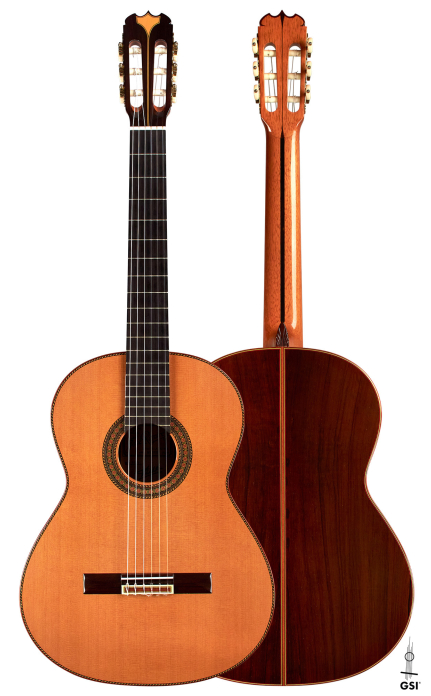
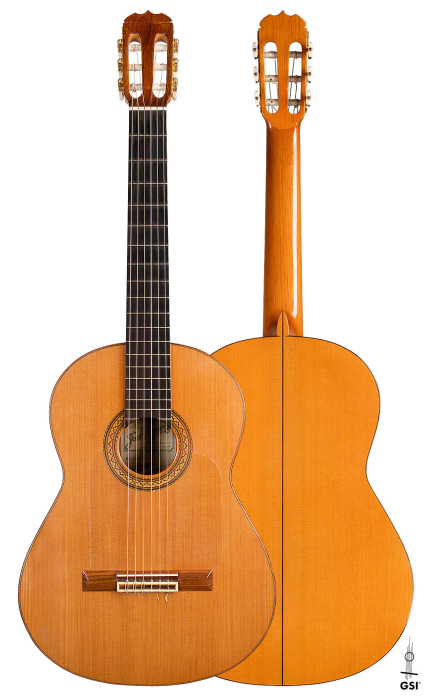
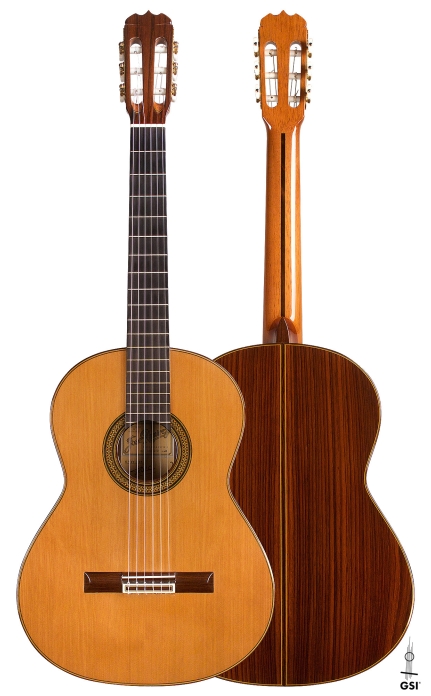
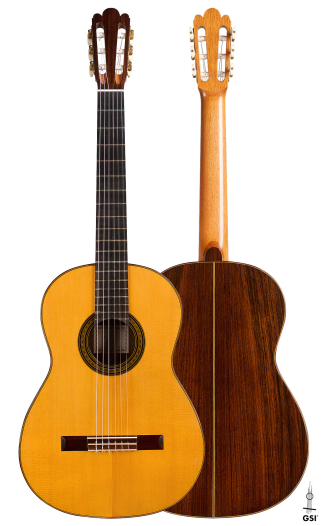
2017 José Ramírez "Guitarra del Tiempo" No. 116 SP/IN
| Year | 2017 |
| Top | Spruce |
| Back & Sides | Indian Rosewood |
| Scale Length | 650 mm |
| Nut width | 52 mm |
| Finish | Lacquer |
| Country | Spain |
| Luthier | Amalia Ramírez |
This guitar is no longer available in our inventory. If it interests you, click the ”notify me when available” button to be notified in the event that we re-acquire this guitar for re-sale.
Videos
Description
This 2017 José Ramírez "Guitarra del Tiempo" No. 116 is a classical guitar with a spruce top and Indian rosewood back and sides in like-new condition; Peter Fletcher plays it in the video above.
Made Under Amalia Ramírez
For more than fifty years, guitars from the José Ramírez workshop have been in the hands of countless professionals, from Segovia to Sting, from Sabicas to Chet Atkins and from Christopher Parkening to Lee Ritenour. Since 2000 the workshop has been in the hands of Amalia Ramírez, and this guitar was made well into her direction.

About the "Guitarra del Tiempo"
Following the "130 Años" in the series of Ramírez anniversary guitars, the "Guitarra del Tiempo" was made a permanent part of the range, its rosette changing from time to time. A newly designed, enhanced top bracing gives it articulate notes and a full-bodied tone.
Condition, Sound and Label
Although a used guitar, it is in like-new condition. The sound is warm yet bold, with ample volume and responsive dynamics; you can feel its power in your belly, and the harmonics sustain across all six strings. Its label, "Studio Guitar – Guitarra del Tiempo", is dated 2017, No. 116 and celebrates "over 135 years since the foundation of our workshop in 1882".
Three Videos
Peter Fletcher plays a Ramírez "Guitarra del Tiempo" in the first video above; in the other two, Amalia Ramírez presents the model and talks about the Ramírez legacy.
Curious about the family? Our blog has The Ramírez Family: Masters of the Guitar, the whole line from Amalia Ramírez back to José I, and a little fact-checking on the myths and facts about this legendary workshop.
Background
The José Ramírez Workshop of Madrid
Founded in Madrid in 1882 by José Ramírez I, the Ramírez workshop has produced guitars for more than a century and through five generations of the family. José Ramírez III (1922–1995) took over as maestro in 1957 and developed the Ramírez concert guitar we know today – large in body, with a long string length and a cedar or spruce top, with great power, sustain, sweetness and balance across the entire register. He popularized western red cedar as a soundboard wood, and from the 1960s Andrés Segovia played José Ramírez guitars to the end of his days.
Ramírez Craftsmen and the Next Generations
From the 1960s to the 1990s the workshop trained many of the most talented guitarreros of the day, among them Paulino Bernabé and Manuel Contreras. In 1995 the shop moved from Calle Concepción Jerónima 2 to Calle de la Paz 8, and since the death of José Ramírez IV in June 2000 the business has been directed by his sister, Amalia Ramírez, who inspects every guitar during and after construction.
The Workshop Under Amalia Ramírez
Under Amalia Ramírez the workshop has kept the classic concert guitar at the heart of its range – the "1a" (first class) in the "Tradicional" design, its model code written by hand on the label: C650 for a cedar top with Indian rosewood, "-A" for a spruce (abeto) top, "-P" for CSA rosewood (palosanto) and "-AP" for both, with F656 and F656-A for the cedar and spruce flamencos. Around it she has built a wider family of models: the "Centenario" and "Elite", made with the workshop's most precious woods; the reissued "SP" and "2a"; the "Auditorio", "Antigua" and "Guitarra del Tiempo"; anniversary series such as the "125 Años" and "130 Años"; replicas of historic guitars, from the 1912 Manuel Ramírez played by Segovia to the 1913 "Guitarra de Tablao" of José Ramírez I; and the studio lines NE, R and FL. The concert guitars carry the Calle de la Paz 8 label, signed by Amalia Ramírez with her star signature and numbered with a letter-and-number code (Centenario and Elite have numbers of their own), while the studio guitars have an orange "Guitarras de Estudio" label, "Diseñada, Revisada y Certificada por Ramírez", with the red "Calidad Ramírez" stamp.