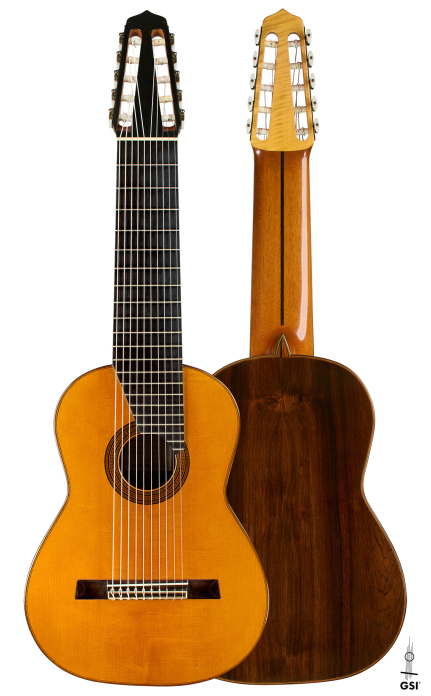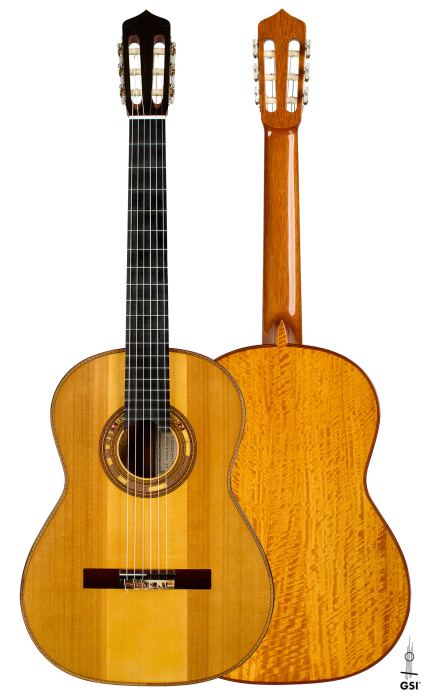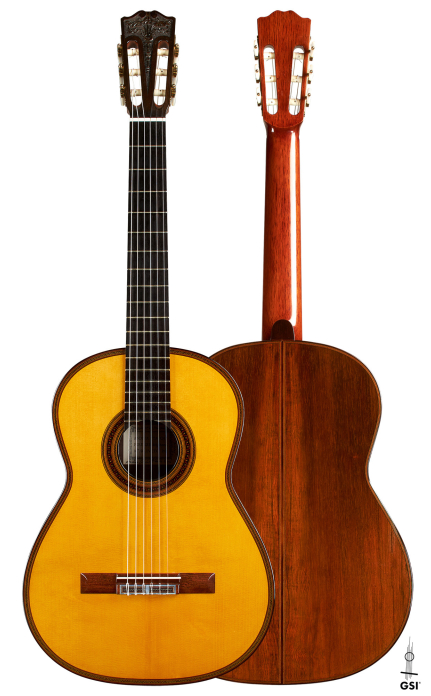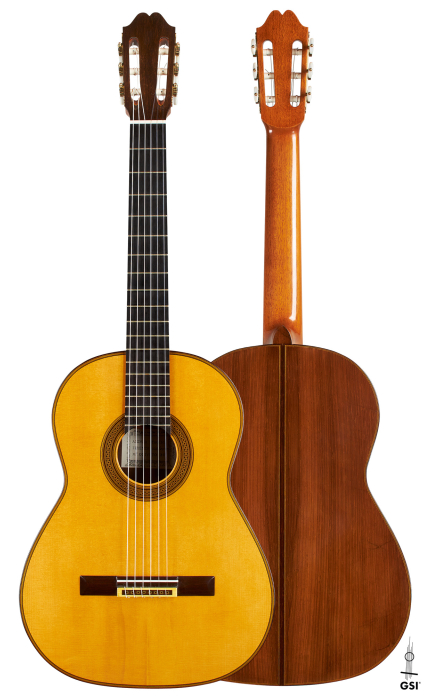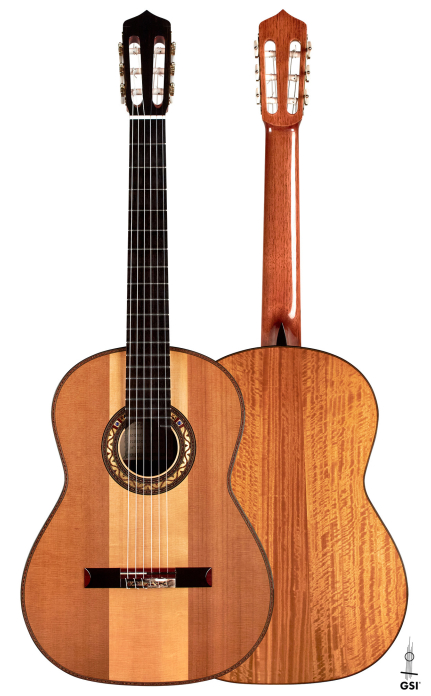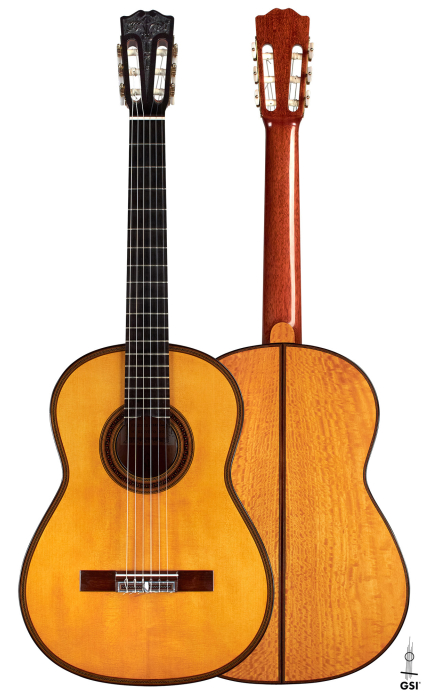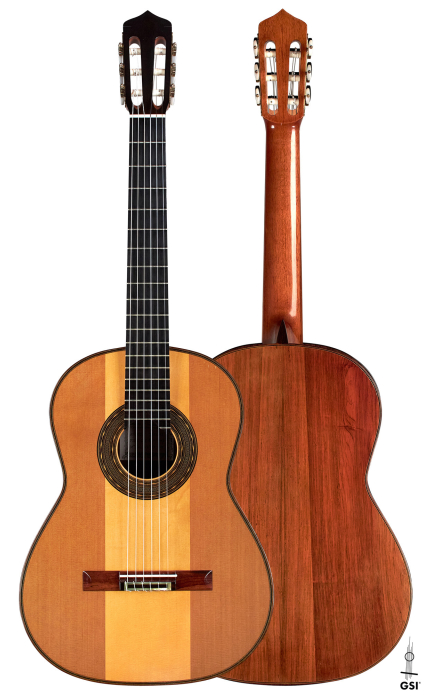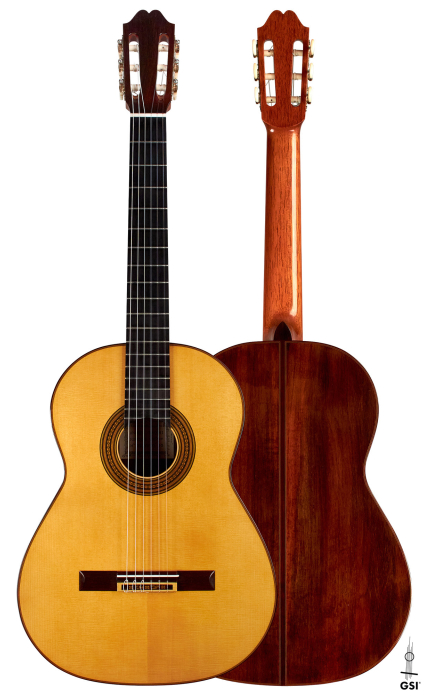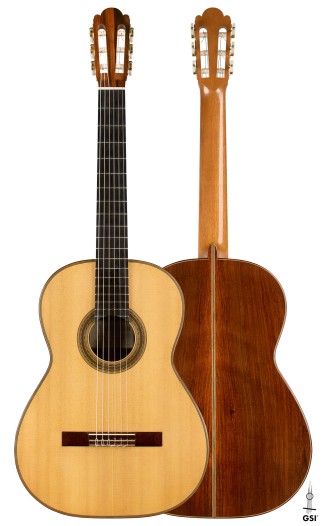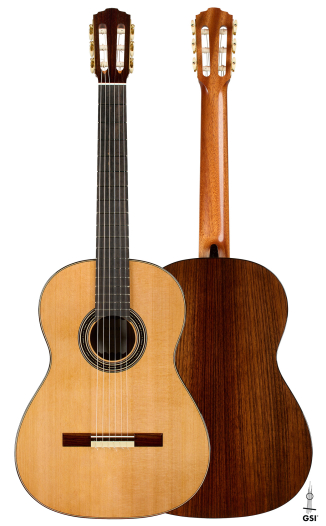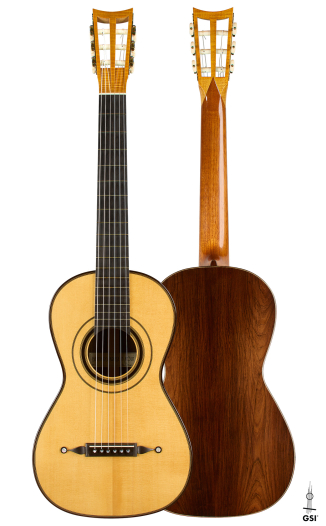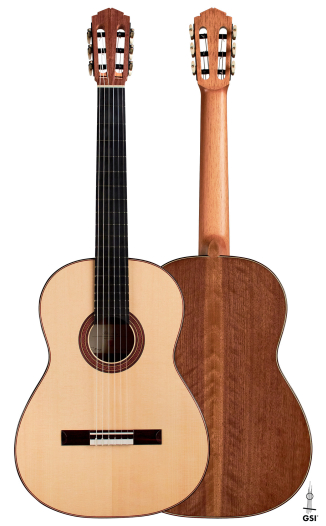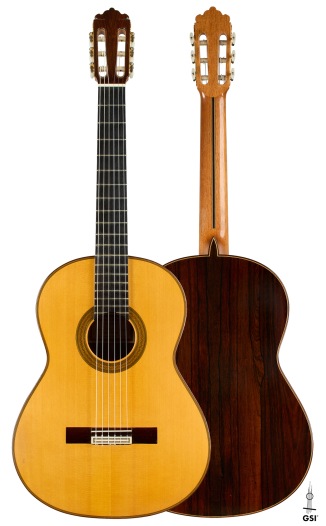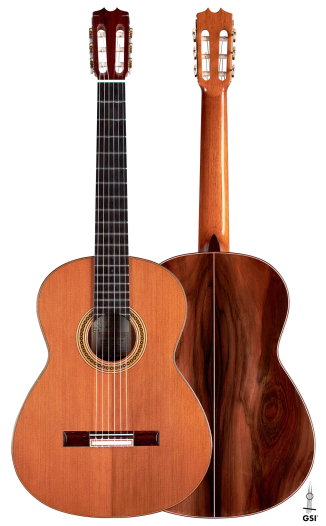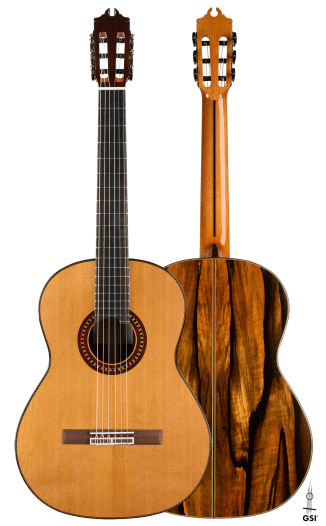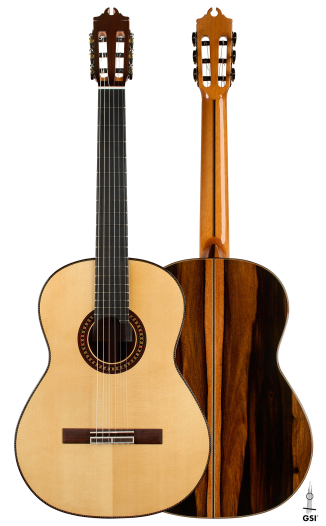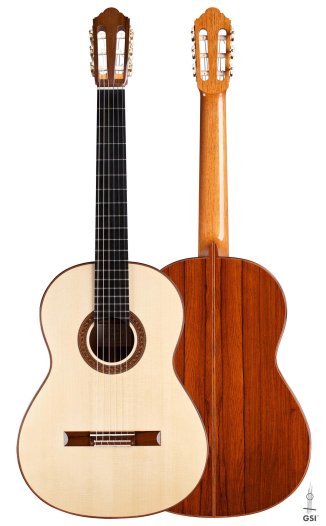



2025 Andrea Tacchi "Coclea Thucea - Fibonacci - T441" CS/SW
| Year | 2025 |
| Top | Cedar/Spruce |
| Back & Sides | Satinwood |
| Scale Length | 654 mm |
| Nut width | 52 mm |
| Finish | French Polish |
| Condition | New |
| Country | Italy |
| Exchange | ExchangePlus |
| Luthier | Andrea Tacchi |


Andrea Tacchi - Luthier (Part 1)

Andrea Tacchi - Luthier (Part 2)

Andrea Tacchi - Luthier (Part 3)
Description
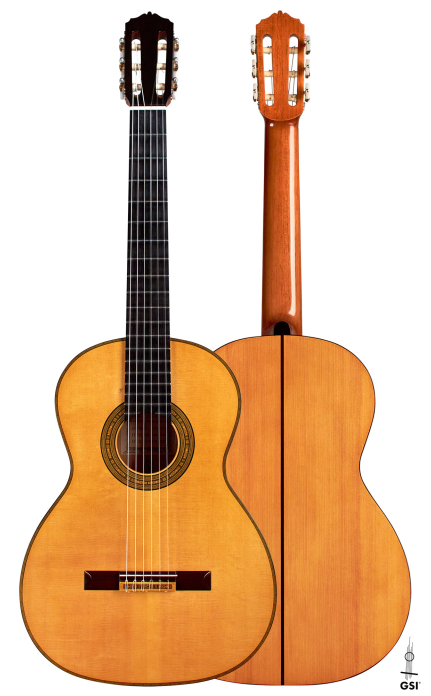
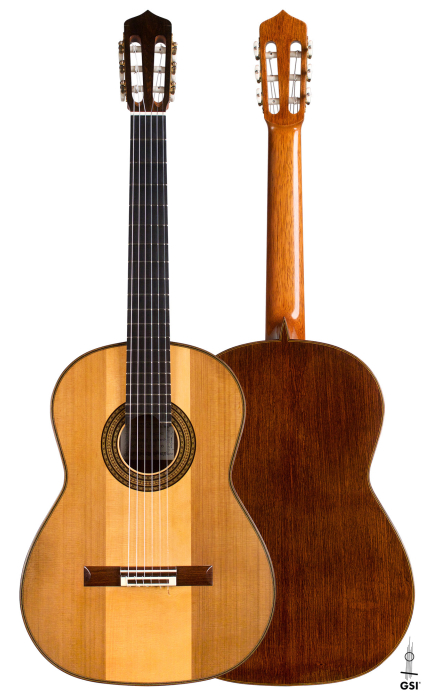
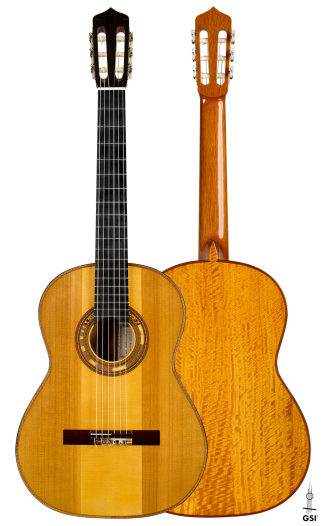
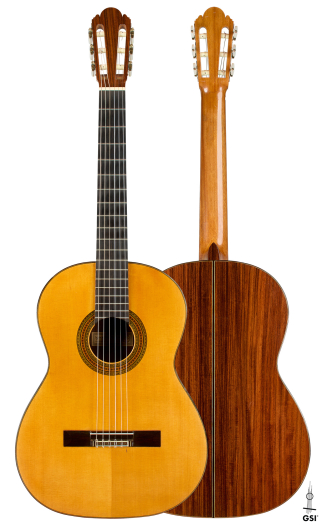
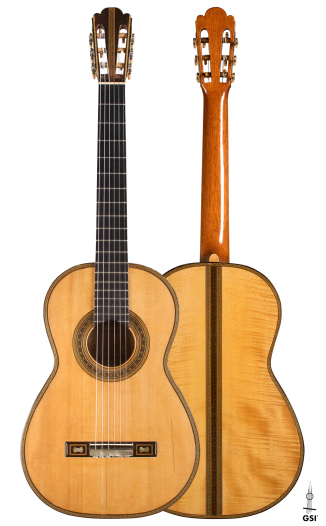
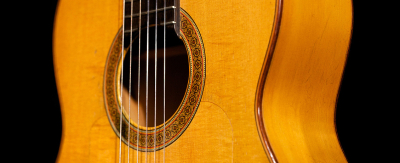
 This 2025 Andrea Tacchi "Coclea Thucea – Fibonacci – T441" is a classical guitar with a cedar and spruce soundboard and satinwood back and sides, handmade in Florence, Italy, by one of the most admired guitar makers in Europe today.
Coclea Thucea: Andrea Tacchi's Flagship Model
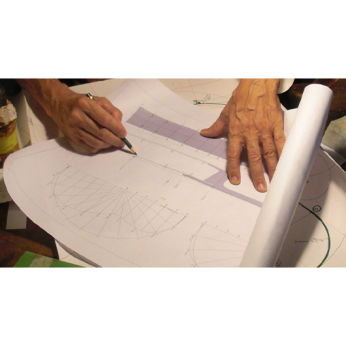
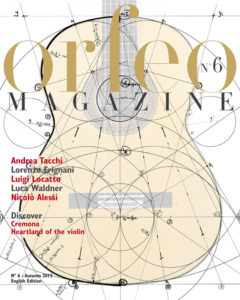
This is Andrea Tacchi's flagship model, the "Coclea Thucea". It is a fusing together of two different design ideas that were developed independently. The first idea was born in 1989, when Tacchi publicly unveiled his "Coclea" model – named after the Latin word for the part of the inner ear that transforms sound vibrations into the psychological sensations of volume, timbre, and tone. It is based on geometric and mathematical concepts that Tacchi discovered in researching old stringed instruments, starting with S. F. Sacconi's book "The Secrets of Stradivari", where Sacconi made sketches of violins and cellos that described the rules of dimensions and proportions that most influenced acoustic properties. Further, Tacchi explored the relationships found in the careful combining of circles and spheres to generate his plantilla (outline shape of the guitar) as well as the side-view shape with its unique back and soundboard doming.
The "Thucea" Top: Lessons from Torres
The second idea (the "Thucea" part of the story) came as a result of Tacchi having evaluated many original Torres guitars and noticing Torres' use of asymmetrical soundboards – center seam locations and the number of pieces of wood used by Torres for his tops seem to have been chosen to ensure that the stiffest pieces of wood were normally found under the bridge area. This realization led Tacchi to develop a four-piece top made with two pieces of western red cedar at the extremities and two pieces of European spruce in the middle, named "Thucea" from the union of the Latin words "Thuja Plicata" (cedar) and "Picea Excelsa" (spruce). Tacchi's idea was to work with woods of different densities (as Torres had done) to maximize the efficiency of sound transmission across the various sections of his soundboards, resulting in improved response and projection.
Satinwood, Gold Leaf and the Fibonacci Rosette
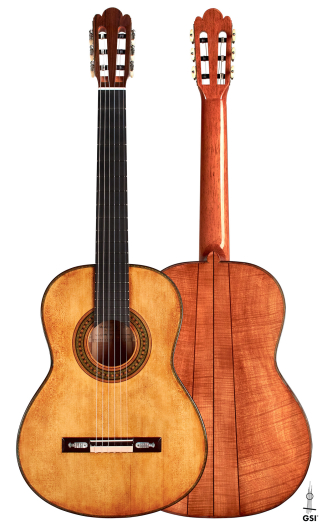
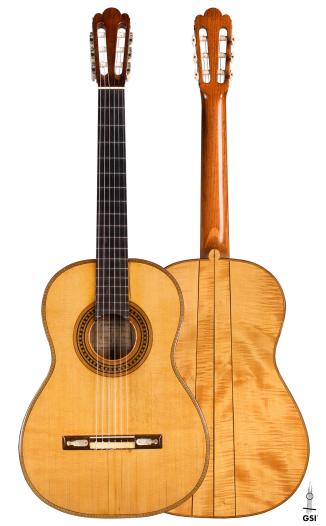
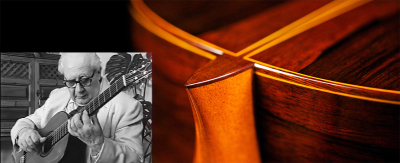
The aesthetics and structural elements of this guitar are quite striking and worth describing in some detail. Firstly, Andrea made a 3-piece back of his best satinwood (cut in the 1960s). The center piece expands in size as it moves from the heel cap to the foot and is met with a triangular inlay in the foot where the sides come together – another very structurally satisfying detail. The brilliant "gold" look of this shimmering wood is matched in the rosette, where he is using gold leaf for some of the inlay work. Specifically, this is a "Fibonacci" model, which is primarily in reference to the rosette design: the inlays of gold leaf are arranged in an expanding Fibonacci sequence, with the spaces in between filled with García-inspired checkered mosaics sized in "golden ratio" proportions generated from each of the preceding gold leaf measurements. In the areas of the rosette nearest the fingerboard and in the tieblock of the bridge, he has inlaid an assortment of bits of gold and a collage of purfling fragments floating in clear epoxy, including 2 semiprecious stones – Red Egyptian diaspro, both inlaid with gold dots.
And because every guitar Andrea builds features unique design elements, this rosette presents a new variation on a theme taken from a guitar he built us in 2019, named "Riflesso". For this new guitar, it features two bands of herringbone inlay that alternate between Bordeaux red and yellow for the foreground and background colors – same with the two bands of blocks on either side of each herringbone strip. This gives the rosette an added depth visually that is stunning – subtle but powerful!
Bridge, Saddle and Varnish
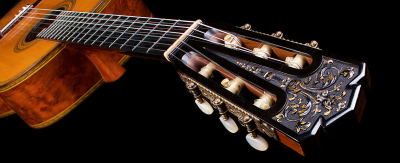
The bridge is Indian rosewood with the tie block capped in goat horn (from Turkey), with more of the purfling fragments and gold pieces in clear epoxy as in the rosette. Even the saddle itself is a composite of bone and carbon fiber to transmit vibration as efficiently as possible – Andrea sees this juncture of "string to body" in much the same delicate way as a needle on a record player. There is also quite a story with the varnish, which took some experimentation until Tacchi was happy. For most of the body he's using a colored red varnish, a technique borrowed from violin and cello makers. He's done this in the past but only with maple; this is his first with satinwood, and he found that he needed to add salt to the finish used on the satinwood only, to give a more interesting deep tone to the wood. He used purely clear shellac for the Amaranto bindings and rosette. Lastly, it is fitted with silver-plated tuners with mother-of-pearl buttons, and a 20th fret.
T441: Capturing the Sound of the Piano
As striking as the guitar looks, it cannot be overstated how remarkable the quality of sound is as well. For this instrument, Tacchi's lifelong love of the piano drove him to try and capture some of the "essence" of the piano and incorporate it into the sound of this instrument. He particularly likes what he calls the "transitory attack" (fast attack with slow decay) of the piano and the "thickness" of its sound – the density of which is so thick that you feel almost as if you can touch it, and which doesn't just enter the listener's ear, but also enters the body. It is named "T441" (Tacchi #441), inspired by Glenn Gould's Steinway "CD 318", which he used for most of his records and concerts.
And this guitar does produce a huge, rich and textured sound, a great variety of timbral colors, polyphonic clarity, and increased volume. Yet another amazing instrument that reconfirms Tacchi's reputation as Italy's top living maker – and the reason top performers have sought out his guitars for so many years. Overall a very sophisticated guitar that achieves exactly what it sets out to do – above all, beauty of sound.
Background
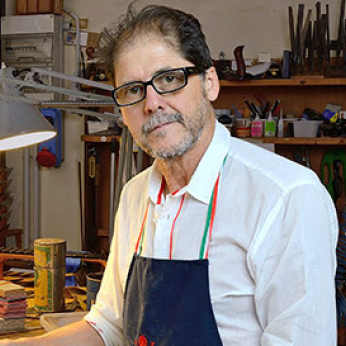
Andrea Tacchi: Master Guitar Maker of Florence
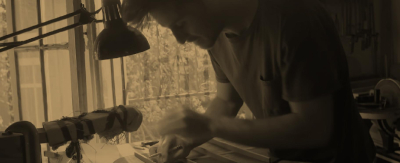
A native of Florence, Italy, Andrea Tacchi is arguably Italy's foremost contemporary luthier and is ranked among the top handful in the world by players and collectors alike. His interest in guitar making started very early in his life – he built his first guitar at age 15. In 1977 he began the serious study of guitar making with Argentinian luthier Ricardo Brané.
Studies with the Great Masters
After Brané's death, Tacchi traveled extensively (starting in the early 1980s) in pursuit of mastering his craft. In Spain he spent time in the workshops of José Ramírez III, Paulino Bernabé Sr., and Francisco & Gabriel Fleta; and in England with José Romanillos. But perhaps his most influential trips were those to France, where he befriended and consulted with Robert Bouchet and Daniel Friederich, whose approaches and aesthetics would greatly impact Tacchi's developing style.
Prizes, Players and Collections
His reputation internationally was boosted in 1985 when he competed in the Concours International des Facteurs de Guitare organized by Robert Vidal of Radio France – Tacchi won first prize for Aesthetic Qualities and second general prize for Acoustic Qualities. His instruments have been played by several notable guitarists including Filomena Moretti, Flavio Cucchi, Carlo Marchione, Antigoni Goni, Robert Gruca, Colin Davin, Minoru Inagaki and Marcelo Kayath, while others belong to important private collections. Two of his guitars are in the collection of the Conservatorio Luigi Cherubini in Florence, Italy.