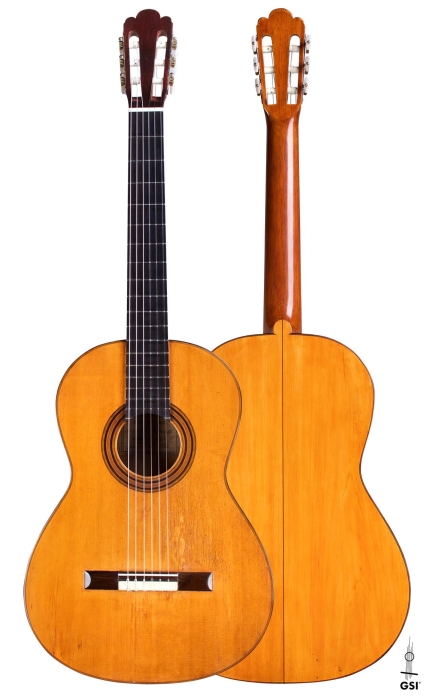
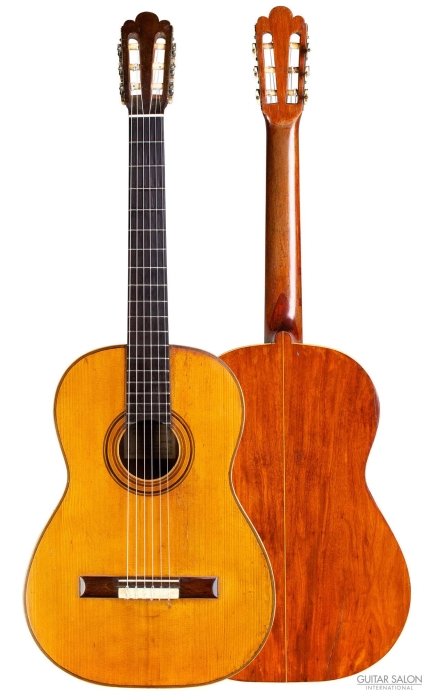
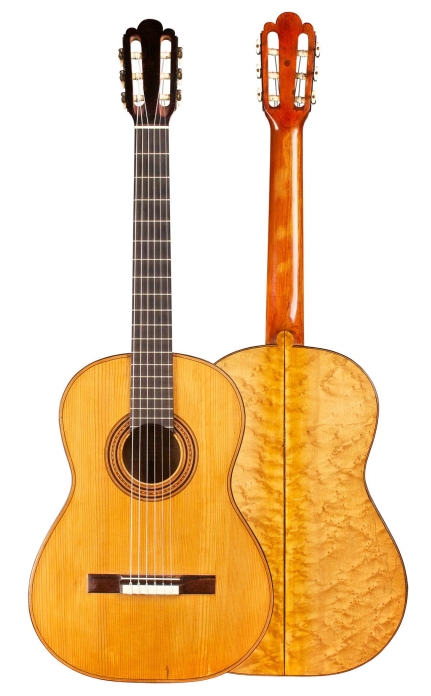
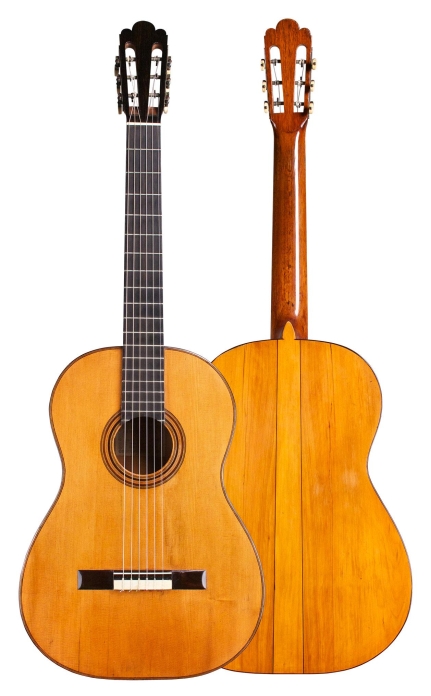
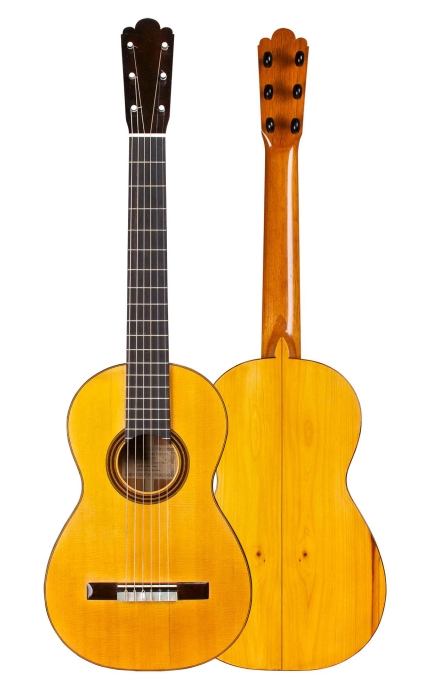
1864 Antonio de Torres "FE 17" SP/MP (ex Francisco Tárrega, María Luisa Anido)
| Year | 1864 |
| Top | Spruce |
| Back & Sides | Maple |
| Scale Length | 650 mm |
| Nut width | 48 mm |
| Finish | French Polish |
| Country | Spain |
| Luthier | Antonio de Torres |
This guitar is no longer available in our inventory. If it interests you, click the ”notify me when available” button to be notified in the event that we re-acquire this guitar for re-sale.


Francisco Tárrega's "Tango Maria" by Pepe Romero on an 1864 Antonio de Torres (ex Francisco Tárrega)

Manuel de Falla's "Canción del Fuego Fatuo" by LAGQ on 4 Antonio de Torres (incl. all 3 ex. Tárrega)

"The Lass of Patie's Mill" (Trad.) by Scott Tennant & Bill Kanengiser on 1864 Torres and 1936 Fleta

Francisco Tárrega's "Mazurka (En Sol)" by Bill Kanengiser on an 1864 Antonio de Torres (ex Tárrega)

Georges Bizet's "Habanera" played by the LAGQ on 4 Antonio de Torres (including all 3 ex. Tárrega)

Francisco Tárrega's "Mazurka: Marieta" by Pepe Romero on an 1864 Antonio de Torres (ex F. Tárrega)

Frederic Hand's "Chorale" played by the LAGQ on 4 Antonio de Torres (including all 3 ex. Tárrega)

Franz Xaver Gruber's "Silent Night" by Scott Tennant & Bill Kanengiser on 1864 Torres and 1936 Fleta

Tárrega's Torres, Fleta & "Silent Night" discussed by Scott Tennant, Bill Kanengiser & David Collett
Description

This 1864 Antonio de Torres "FE 17" is a spruce and maple classical guitar made in Seville for Torres himself – the first of Francisco Tárrega's three Torres guitars, later owned by María Luisa Anido and today by Jonathan Kellerman.
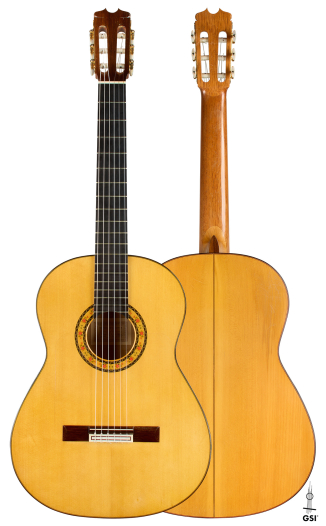
In the videos above, Pepe Romero plays Tárrega's "Tango María" and "Mazurka: Marieta", Bill Kanengiser plays "Mazurka en Sol", and Scott Tennant and Bill Kanengiser play duets on this Torres and the 1936 Fleta it inspired – then talk about both guitars with David Collett. The LAGQ also plays it in three quartets recorded on four Torres.
Torres' Own Guitar, Given to the Young Tárrega
This instrument, built in 1864 in Seville and numbered "FE 17" in the José Romanillos catalog, was originally built by Torres for himself (he was also a very good player). Five years after building it, Torres would allow a young, seventeen-year-old Francisco Tárrega to have the guitar, after being smitten by the young man's talent as an up-and-coming future star – a promise that of course would be fulfilled in Tárrega's lifetime, leaving a legacy that remains to the present day. This instrument would be the first of three Torres instruments owned by Tárrega over the course of his life.
María Luisa Anido and Buenos Aires
After Tárrega's death in 1909, "FE 17" would be the first of the 3 Torres to be sold by his family – in 1917, to Juan Carlos Anido of Buenos Aires, Argentina, for his daughter María Luisa Anido, favorite pupil and eventual duo partner of Miguel Llobet. This instrument was highly regarded not only by Tárrega but also by many of his contemporaries, including Domingo Prat and Emilio Pujol, both of whom had made attempts to become its next owner, only to be outbid by the Anidos – which according to Prat was a "national disgrace"! During its tenure in Argentina, an elegant custom-made case of book-matched, high-grade Cuban mahogany trimmed in CSA rosewood and inlaid with violin purfling was built by one Francisco Voigtlaender of Buenos Aires, and it still houses the instrument to this day.
Repair Labels from Enrique García to Luca Waldner
From its earliest years the guitar required regular maintenance due to its delicate build and intense, regular use by Tárrega. Internally, several repair labels were added over the decades, starting with Enrique García in Barcelona in 1897 and followed by J. Farré in 1984, culminating with Luca Waldner in 2005. Curiously missing is a repair label from Ignacio Fleta, who did some repairs in 1936 and who, while in possession of this Torres, was inspired to build a gorgeous structural copy (its inlays and aesthetic details strongly connected to the Barcelona school of García and Simplicio instead).
The final round of restoration by Luca Waldner deserves special mention for the meticulous and almost miraculous job he did in "undoing" some of the more invasive prior repair work and restoring the guitar as closely to the original as humanly possible. And the "proof is in the pudding", as they say: the sound of the guitar is magnificent to all those who hear it. Its current owner, Jonathan Kellerman, remarks in his book "With Strings Attached" that "We will never know how this masterpiece sounded 140 years ago, but my sense is that Waldner has come close – in effect, accomplishing a miracle of time travel."
The Meander Pattern and an Inspiring Design
The instrument is not only sonically beautiful – it has also become an inspiration for countless luthiers over the past century for its elegant and timeless design. The meander pattern, which according to Romanillos was first introduced by Torres to the world of lutherie, is found in the center of the headstock, central back strip and foot, flanked by half-herringbone purflings (full herringbone in the back). It also has a sophisticated and beautifully executed rosette containing a central mosaic of checkerboard pattern with multiple layers of purfling, including herringbone and a line of lozenges at the outer layer. The lozenge details also appear in the wings of the bridge, where they form rectangular boxes containing dumbbell-shaped mother-of-pearl inlays. This is an instrument built with great structural balance and artistic insight only attributable to the genius of this great maker.
Special thanks to Jonathan Kellerman for generously allowing this guitar to be reunited in our showroom with the other two Torres guitars of Tárrega, after over 100 years of separation!
Further Reading on Torres
For more on the life of Antonio de Torres, be sure to read his biography and this excerpt about the Torres sound from José Luis Romanillos's book "Antonio de Torres". We also have an interview between Pepe Romero and Kenny Hill about the master luthier. Also see Orfeo Magazine #9 – The 200th Anniversary of Antonio de Torres.