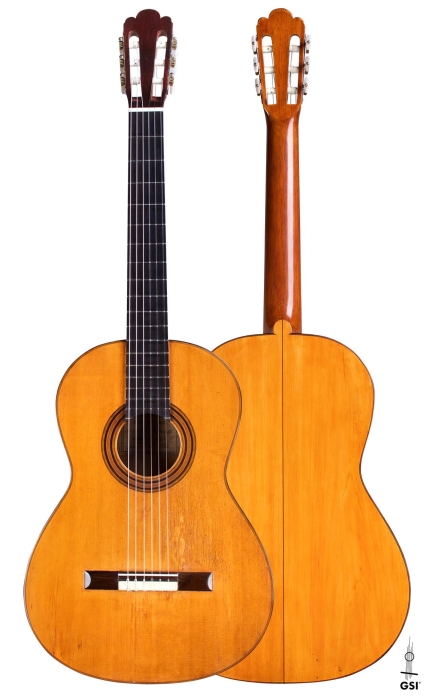
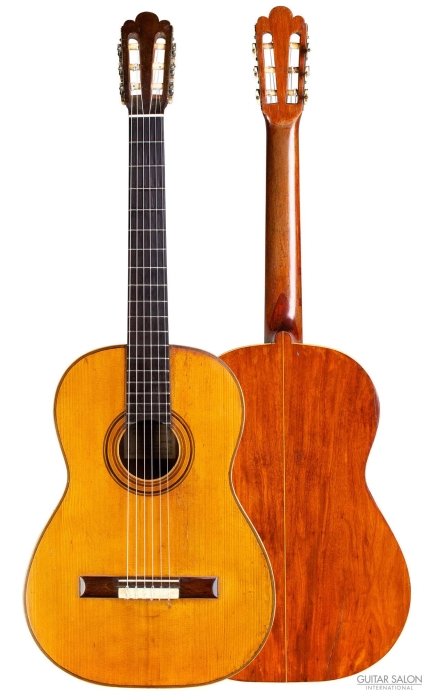
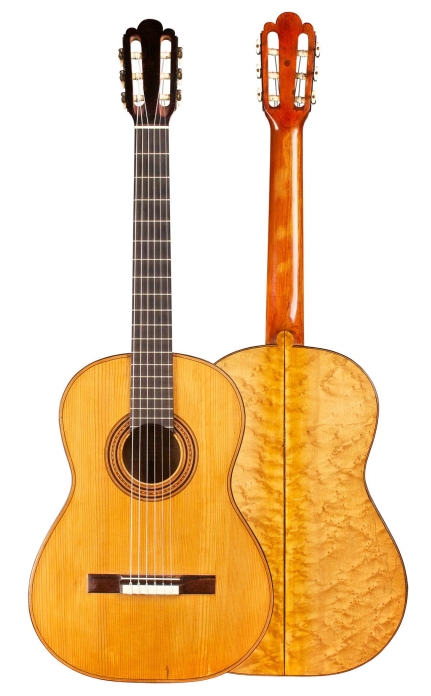
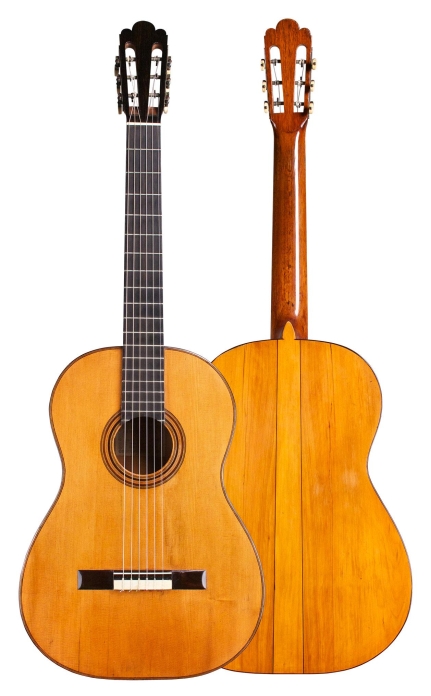
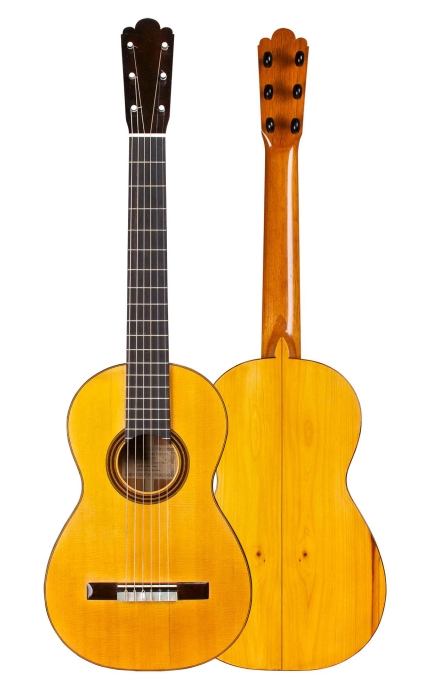
This spruce and mahogany classical guitar carries an Antonio de Torres label dated 1860, but was most likely built c. 1918–1920 in Barcelona by Enrique García and Francisco Simplicio – a showpiece modeled on Torres' famous "cumbre" guitar of 1858.
A Masterpiece After Torres' "Cumbre" FE 08
This magisterial instrument truly deserves to be regarded as one of the great masterpieces of guitar making. Clearly, it was modeled heavily on the famous "cumbre" guitar of Antonio de Torres from 1858 ("FE 08") and is a virtuosic woodworking wonder with its myriad of inlays in various styles – herringbone, meander, checker patterns and other geometrical shapes made of various woods and mother-of-pearl. These inlays appear most prominently in multiple strips of various thicknesses in the sides, back and headstock. It is an absolute marvel to behold.
It also sounds and plays as magically as it looks – it has that old-world quality found in instruments of this vintage that is hard to describe: very lyrical trebles and deep basses. This effect is enhanced by its tornavoz, a conical tube attached to the soundhole, which adds a sonic boom to the bottom end and gives the trebles a brilliant clarity.
Who Built It? Enrique García and Francisco Simplicio
The guitar is in excellent condition – Fritz Ober did some restoration work on it several years ago and was able to examine the interior in detail during his work, which led to some interesting discoveries. After extensive research and consulting with many of our expert friends around the world (including Fritz Ober, Yuris Zeltins, Diego Milanese and several others), we are confident that this guitar was not made in 1860 in Seville by Torres – even though its label reads "Por D. Antonio de Torres, Sevilla, Calle de la Cerrajería, número 32, año de 1860" – but most likely c. 1918–1920 in Barcelona. Many subtle features throughout, including external design details and stylistic idiosyncrasies in the hand-work, as well as internal evidence in the bracing, lining and other structural elements, point to Enrique García and Francisco Simplicio as the likeliest of its creators.
If this is the case, the question arises: "Why would the most respected and famous guitar maker of his day (García), at the peak of his career, be willing to put in the Herculean effort required to produce such a showpiece, only to not take credit for it?" As is well documented, many builders after Torres (including, most famously, Manuel Ramírez) built replicas of the master's work but claimed their own authorship. This was done for a variety of reasons – sometimes in an effort to discover and better understand Torres' secrets, or simply to rise to the challenge of testing one's woodworking skills when confronted with such work as a guitar like FE 08. This tradition is still alive and well today, carried on by many, including Kenneth Brögger, Gabriele Lodi, Luigi Locatto and a host of other highly skilled luthiers. One possibility is that García and Simplicio did originally install one of their own labels, but the label was changed at a later date by someone else. Indeed José Romanillos himself says in his authoritative work on Torres that "Copies were made by very able guitar makers such as Enrique Garcia and Francisco Simplicio as their own instruments, whose original identity was obscured when they lost their original labels. These can be fine instruments that keep within the format and general style of Torres, conserving tornavoces, woods, and even the characteristic ornamentation." We believe this is likely the case with this instrument.
The Torres Tradition
The significance and impact that the work of Antonio de Torres has had on the guitar world is just as strong today as it was in his own time. His instruments have mesmerized all generations of players and makers who have come into contact with them. The inspiration that has gripped the many luthiers who have come under their spell has led to an amazing tradition of replicas and tributes to the master. This instrument, in our opinion, is among the greatest examples in this enduring tradition.
GSI Foundation
This guitar was donated to our non-profit charitable organization, the GSI Foundation. Guitar sales through the GSI Foundation raise money to directly benefit music education in public schools.