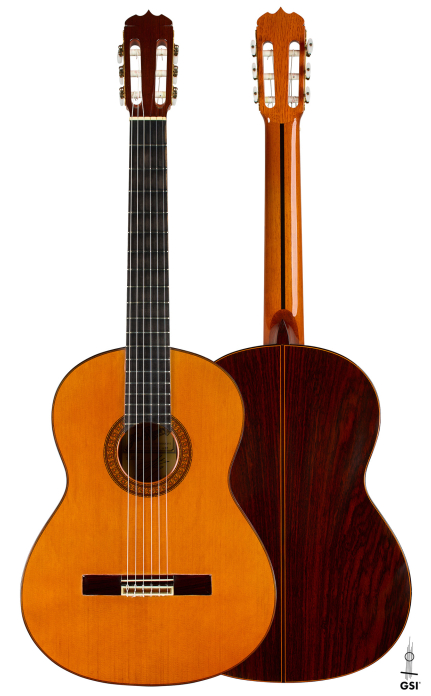
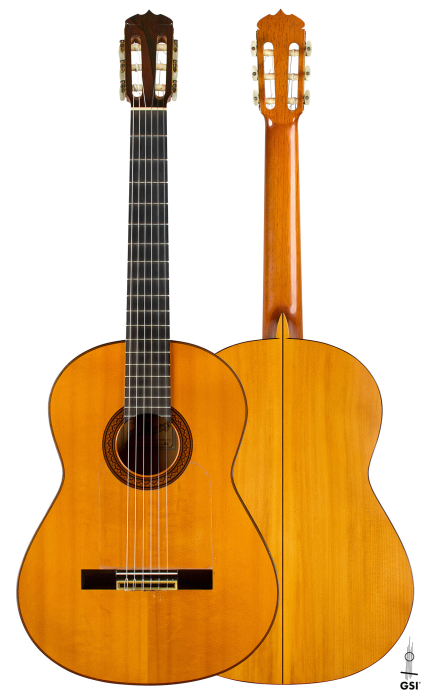
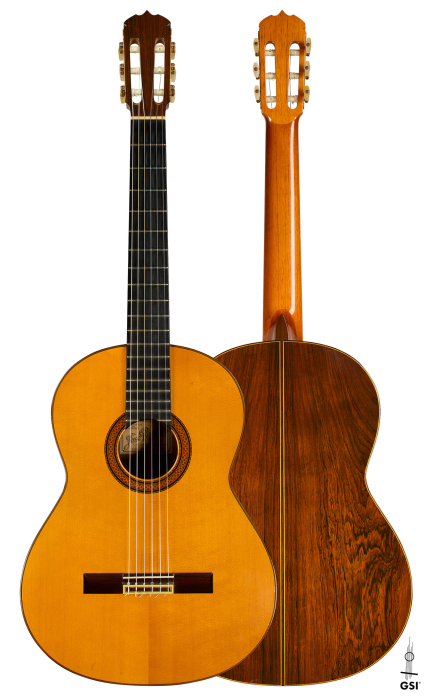
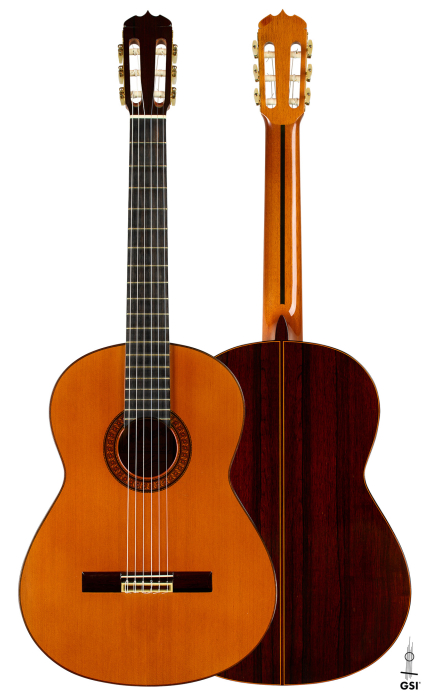
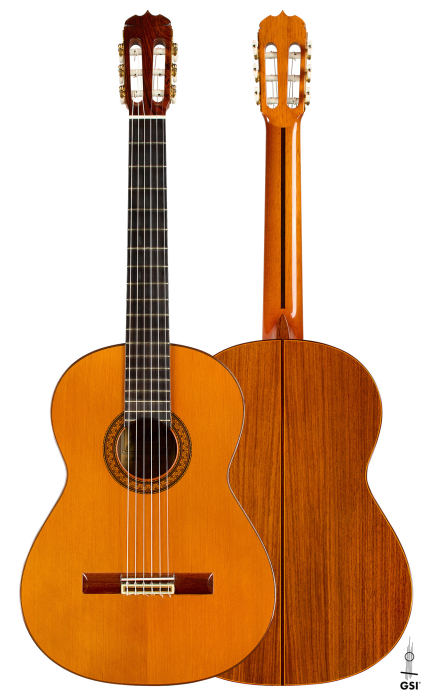
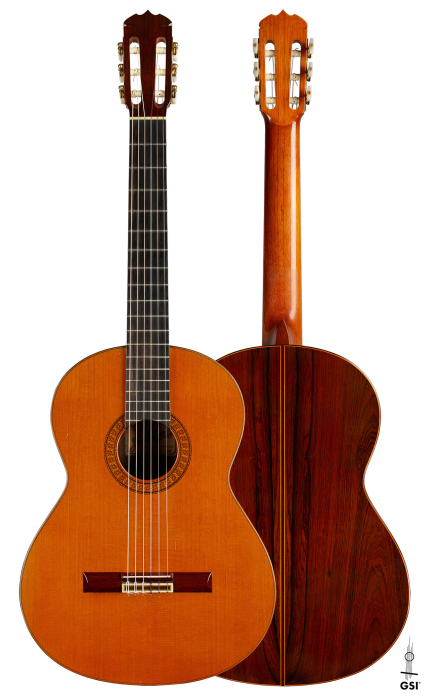
José Ramírez III (1922–1995) was the Madrid guitar maker who designed the modern Ramírez concert guitar – the "1a" – and one of the most influential luthiers of the 20th century. He popularized cedar soundboards and the long string length, and from the 1960s Andrés Segovia played his guitars to the end of his days.
At a Glance
- Born: 1922, Buenos Aires, Argentina
- Died: 1995
- Workshop: José Ramírez, Madrid (maestro from 1957)
- Innovations: western red cedar tops; the long string length; a standardized workshop system; the "1a" concert model
- Trained: Paulino Bernabé, Manuel Contreras, Mariano Tezanos and many others
- Played by: Andrés Segovia, Christopher Parkening, Sabicas and countless others
- Labels: year only until 1967; numbered and signed by José III from 1967; separate "R" numbers for the 2a from 1973
- Family: son of José Ramírez II; father of José Ramírez IV and Amalia Ramírez
One of the Most Influential Luthiers of the 20th Century
José Ramírez III (1922–1995) was without doubt one of the most influential and important luthiers in the second part of the 20th century. His guitars influenced hundreds of instrument makers, many of whom imitated him, and thousands of guitarists who played his instruments. Indirectly, he even influenced composers of the guitar, who found for the first time that their music could be heard in large concert halls instead of small chamber music environments. It could be argued that José III had a more profound effect on the development of the modern guitar than any other guitar maker in history.
So what was his secret, and why do we make such sweeping claims about his importance? One paramount reason is that José III was the first and only luthier to be able to standardize the process of making a classical guitar such that it could be built by any well-trained artisan, according to his precise plan and under his supervision. Moreover, the design was such that these instruments, although not made by him personally, stood up to and often exceeded the quality of the best handmade instruments of the day.
From Buenos Aires to the Madrid Workshop

José Ramírez III was born in Buenos Aires, Argentina, in 1922. His father José II had left Spain for a brief tour of South America after the turn of the century and ended up staying for nearly 20 years. In 1923, on the news of the death of his own father, José II moved the family back to Madrid, and it was at this time that he took over his late father's guitar workshop. At the age of 18, José III began working as an apprentice and within a few years was building guitars and experimenting on his own. In 1957 he took over the duties as "maestro" (master) of the Ramírez workshop, which by now had spanned three generations, and he continued to develop what would become the Ramírez concert guitar that we know today. This instrument was typified by its large body, long string length, and cedar or spruce top. It had great power, as well as sustain, sweetness, a fullness of tone and a balance across the entire register. José III died in 1995 at the age of 73.
A Teacher and Developer of Talent
Probably his most enduring contribution was his role as a teacher and as a developer of talent. We often measure a man's greatness not only by what he achieves in his lifetime, but by what he leaves behind for others to complete, and by how he influences those in his wake. From the 1960s to the 1990s, the José Ramírez workshop had assembled and trained many of the most talented guitarreros of José III's generation, many of whom continue to work on their own with great individual success. This collection of greatness under one roof has only been approached by that of Manuel Ramírez (José III's great-uncle) or his grandfather, José Ramírez I, whose workshops collectively included the likes of Santos Hernández, Enrique García, Domingo Esteso, Emilio Pascual Viudes, Modesto Borreguero, Julián Gómez Ramírez and many others.
José III's roster, however, is still unmatched when you consider the number of great luthiers who began their careers there. They include Paulino Bernabé, Manuel Contreras, Mariano Tezanos, Enrique Borreguero Marcos, Pedro Contreras Valbuena, Manuel González Contreras, Miguel Malo Martínez and so on.
"I make sure that everything is done exactly as I want it," José III told George Clinton in 1984. "The architect doesn't have to get involved with the bricklaying. My pupils learn from me so they know exactly what is to be done, otherwise I would do it myself. The wood and the tools have no secrets from me, and if there are problems I have to sort them out."
Some 20,000 Concert Guitars
Quantity is not always a virtue, especially in art or the work of artisans. However, in the case of José III, his guitars became the standard for musicians worldwide because he was able to produce roughly 20,000 concert instruments during the course of his lifetime, which was somewhere between 20 and 40 times that of his average competitor. Not only did José III succeed in seducing the majority of concert artists of his day to play Ramírez guitars, but he provided instruments to their students, as well as to several generations of the amateurs who followed them.
Cedar Tops and the Long String Length
The second reason for Ramírez pre-eminence as master guitar maker was his capacity for innovation. He experimented with the use of western red cedar from North America as a tonewood for the soundboard, and eventually popularized it as the alternative to northern European spruce, which had been the standard for virtually all stringed instruments including pianos, violins and lutes.
"We had some old instruments made of a sort of red-coloured spruce and with a very straight grain," José III told Clinton. "It was impossible to obtain this sort of wood, but you might have come near to it with some very old furniture… Well, one day I sent one of my young fellows to buy wood and when he returned he said the supplier had what he thought was Honduras cedar. I told him to go back and bring a sample. When he returned I saw immediately that the wood had the characteristics I had always been looking for. I went myself and bought a large piece of trunk, took it to the workshop, and cut a top from it. I gave it to one of my craftsmen and told him to build a top from it. When the guitar was finished we realized at once that although this wood required a different working, it was not only good but superior. At first I was criticized for using it, but little by little more makers realized its worth and changed to it."
This use of cedar was one of the most important and significant developments in the history of the modern guitar. If anyone doubts this, consider that this wood has become the preferred soundboard material for the instruments of the majority of guitar-playing concert artists, including Pepe Romero, John Williams, Christopher Parkening and Manuel Barrueco, to name a few. It also became the preferred wood for tops among several of the world's most acclaimed luthiers, such as Ignacio Fleta, Daniel Friederich and Miguel Rodríguez Jr. Another remarkable and central innovation occurred in the 1960s when, most probably at the request or influence of Andrés Segovia, José III began to introduce the long string length of 664 mm in his guitars. This gave the instrument more power to project in a large concert hall and also accommodated the huge hands of the maestro. Although it has in recent years fallen out of favor, this increased string length became the standard among guitar makers and guitarists throughout the 1960s and 1970s, and is still preferred today by many performers who need to fill large concert halls, or those who are lucky enough to find themselves playing with an orchestra.
The "1a" and Andrés Segovia
All of José III's innovations led to his building of one particular model, the "1A Tradicional" we know today, amongst improvements to other models. Many world-renowned players were immediately drawn to this new guitar, among them Andrés Segovia, who began his career with a guitar made by Manuel Ramírez. After opting for a German instrument (Hermann Hauser) for many years, in the 1960s Segovia decided to return to a Spanish instrument. Partly because of nationalistic sentiment, but also due to the need for a guitar with enough volume to fill a large concert hall, he played on José Ramírez guitars to the end of his days. Thus one of the greatest careers in the history of the classical guitar began and ended with Ramírez guitars.
"The Sound Is Purely a Product of Physics"

José III did not, of course, arrive at his designs through chance, and experimented widely. "I've tried everything," he told Clinton. "Double top; double back; I know all about Lacôte and his experiments with double tops… Look inside the guitar! We are just doing what 90 percent of guitar makers have done before. Everybody has a look at the secrets." He also realized early in his career that some people appeared to miss what seems self-evident: the primary aim should be to achieve a fine-sounding instrument. "When I couldn't achieve this I was very upset, and then I determined to study the guitar hard. I soon realized that the guitar was a very detailed work and that I needed more knowledge about the physics and the science. There might be a little art in making the rosette and putting the guitar together, but the sound is purely a product of physics. I know I'm not doing myself any favors in saying this, because I would like to be thought of as an artist. But it is so."
Finally, although there has been much said about José III over the years, it cannot be denied that the guitar which he designed in the early 1960s still stands as the world standard of the concert classical guitar, a standard by which all other guitars are measured and will be measured in years to come.
– Tim Miklaucic, from The Classical Guitar: A Complete History, published by Balafon Books, 1997
Reading a José Ramírez III Label

Having handled well over a hundred of José III's guitars in our museum, we've learned a great deal from their labels. Until 1967 the labels carried only the year, written in by hand – a cream label with a blue-grey border for the first-class guitars, and an early "gold label" with red lettering for the "2a". In 1967 the workshop introduced a larger label with a lower panel, signed by José Ramírez III and giving the guitar's number and its class ("Clase 1ª"). The numbers in our museum run from about 2,000 in 1967 to around 4,400 in 1970, 8,600 in 1975 and 18,800 by 1985. From around 1987 the workshop moved to letter series (A 793 in 1987, A2480 in 1990), and later to codes such as H5-771, I2-025 and Z8-105, often with the string length written by hand on the label – "C664" or "C650".
From 1973 the "2a" had a label of its own – grey with a red border – and a separate numbering with an "R" prefix, from R1100 in 1973 to R1909 in 1988. The "2a" models are pretty much identical to the standard "1a" in all ways; the shop claimed back in the day that the lower price tag was due to materials that may have minor aesthetic blemishes, such as small knots or "cocas" (darker areas of resin concentration in the grain), or to the guitar having been built by an apprentice and not a foreman – and after many decades of discussion, many players and aficionados have concluded that a great 2a can be identical to a great 1a. The Centenario guitars had a label and numbering of their own (No. 24 in 1981, No. 101 in 1992), and many guitars sold in America also carry the small green sticker of the distributor, Antigua Casa Sherry-Brener ("Modelo Segovia – Hecho a Mano").
Builders' Stamps Inside the Guitar
Until 1971, many Ramírez guitars were stamped inside with the initials of the craftsman who built them: AM for Antonio Martínez and MT for Mariano Tezanos – the most sought-after of all, not least because Segovia's own favorites were an MT and an AM – as well as PB (Paulino Bernabé), MG (Manuel Contreras), MC (Manuel Cáceres), MM (Miguel Malo), PC (Pedro Contreras Valbuena), IM (Ignacio Manzano Rozas), AS (Arturo Sanzano), CLL (Carmelo Llerena), JG (Juan García Rey) and JF (José Flores Duro). FM was used twice: first by Félix Manzanero and, years later, by Fernando Morcuende. After 1971 the initials disappear, although some builders marked their guitars with a number instead – our 1974 "2a" by Mariano Tezanos is stamped "2". For more names, see our list of Ramírez workshop luthiers.
The C86, the Centenario and the Later Models
For some twenty years the Japanese distributor Shiro Arai asked José III for a shorter-scale guitar for players with smaller hands. In 1986 José III finally gave in and designed one with proportions to match – a smaller body and a 650 mm string length – and named it the "C86" after its year; it has a beautiful, delicate and intimate voice, with a little less projection than the long-scale 1a. The "Centenario", made from the workshop's finest stored woods with extra decoration, roughly marks the hundred years of the Ramírez family's guitar making, and the "Da Cámara" – recognizable by the dot on the headstock – has a wooden "shelf" around the inside of the sides. In 1988 José Ramírez IV took over the management of the workshop with his sister Amalia; he redesigned the short-scale guitar, and in the 1990s the classic cypress-lined 1a was named "Tradicional" alongside his new "Especial". From then on some labels carry José IV's signature, or Amalia's – hers is easy to spot by its star shape.
José Ramírez Guitars at GSI
Many José Ramírez guitars have passed through our doors over the years. You'll find guitars currently in stock by clicking the "Guitars In Stock" button in the header of this page as well as earlier examples in our Museum by clicking the "Guitars In Museum" button.
Frequently Asked Questions
Who was José Ramírez III?
The Madrid guitar maker (1922–1995) who designed the modern Ramírez "1a" concert guitar and led the Ramírez workshop from 1957.
Did Segovia play Ramírez guitars?
Yes – after many years on a Hauser, Segovia returned to Spanish guitars in the 1960s and played José Ramírez guitars to the end of his days.
Why are Ramírez guitars often made with cedar tops?
José III popularized western red cedar as a soundboard wood; it became the preferred top for many concert artists and makers.
How do I date a José Ramírez guitar?
By its label: until 1967 only the year is written in; from 1967 the label is signed by José III and also gives the number and class, so the number confirms the year even when the date was left blank.
What is the difference between a Ramírez 1a and 2a?
The "2a" models are pretty much identical to the "1a"; the shop attributed the lower price to minor aesthetic blemishes in the wood or to an apprentice having built it, and many players feel a great 2a can be identical to a great 1a. From 1973 the 2a had its own red-bordered label and "R" numbers.
What do the initials stamped inside a Ramírez mean?
They identify the craftsman who built the guitar – AM for Antonio Martínez, MT for Mariano Tezanos, PB for Paulino Bernabé and so on. The workshop stopped stamping initials in 1971.
What is a Ramírez C86?
The shorter-scale model José Ramírez III designed in 1986, with a smaller body and a delicate, intimate voice.